-
How I Learned to Stop Worrying About Groceries and Love Košík.cz
My goodness, it’s hard to believe about many things in this world.
It’s hard to believe that more time has passed between the Stegosaurus and T-Rex than between T-Rex and humans.
It’s hard to believe that Lake Superior has a larger surface area than the entire Czech Republic.
And it’s hard to believe that I haven’t updated this blog nearly ten months despite living in the Czech Republic for over three and half years now.
Dear reader, you might wonder what sort of wisdom I’ve accrued in this time, or what has happened to my initial wonderment after settling in for an extended period of time. Maybe you’ve wondered how I managed to conquer the seemingly simple act of grocery shopping, when local “supermarkets” often don’t have basic staples like soap.
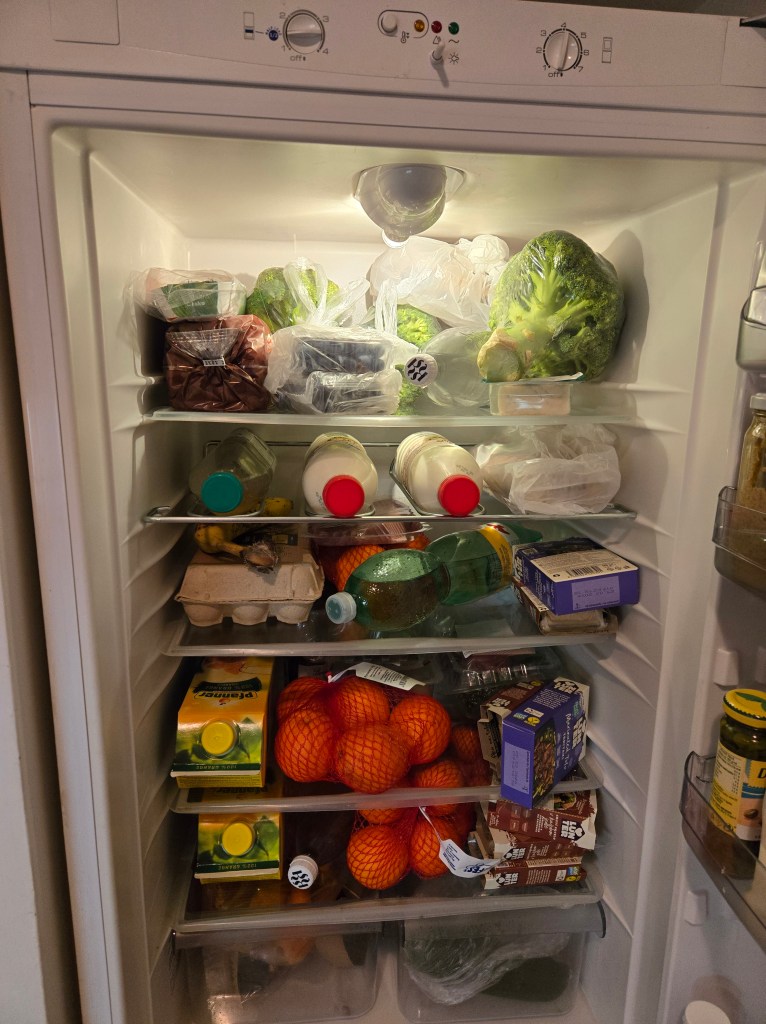
If you’re new Prague, or thinking about moving to Prague, try this trick in order to easily fill your fridge in a land of less-than stellar grocery market choices. Well, for any American currently considering an extended stay in the Czech Republic, that is indeed a very good question. Prior to my arrival, I had read few blogs and watched a videos from other Americans who stated, in rather broad terms, that grocery shopping in the Czech Republic isn’t quite as convenient as American stores. However, that is quite an understatement.
To make a long story short, you can mostly forget about the convenience of “one-stop shopping.” Also, your options for shopping are largely dictated by whatever neighborhood you live in. For example, when I first arrived in Holešovice, I had luxury of living in a densely populated urban area with a high percentage of American expats. There were multiple grocery stores within walking distance, and the nearest farmer’s market was a short tram ride away.
That was lovely.
However, when I moved to Střešovice, I unknowingly made a devil’s bargain. In exchange for quiet, tree-lined streets and stately homes, I lost any reasonable access to a quality supermarket.
Thus, travelers beware, as this might happen to you. Your neighborhood might have an Albert or Billa. These are close approximations to Stop N’ Shop in my native New England, although the selection, is much, much smaller. If you want anything remotely resembling the level of choice that you have in the United States, your options are Tesco or Kaufland. Again, this is another devil’s bargain. While Albert and Billa have good prices and poor selection, Tesco and Kaufland have good selection and poor prices–as in, the prices will make you poor if you shop there regularly.
And yet the complexity of Prague grocery shopping doesn’t stop there. You see, not all Billas and Alberts are created equal. The BIlla that I lived closest to, prior to its recent remodeling, generally had not only bad selection but bad quality produce to go with it. That, along with dirty floors and crud that seemed to perpetually drop from the ceiling meant that any meaningful shopping trip meant a thirty-minute tram ride to the next nearest Billa–you know, the one that doesn’t stock soap.
For years, grocery shopping was a hassle for me. Purchasing anything had to be carefully planned based on where I was at a given moment, or if I wanted to sacrifice a solid part of my weekend for a “big” shopping trip that wouldn’t be able to cover all of my needs anyway. And boy, it was embarrassing every time I had people over and I tried to welcome them by saying, “help yourself to anything you want in the fridge.” Invites like this typically resulted in a guest who would open the fridge to find it nearly barren, then look at me and wonder how I hadn’t yet starved to death.
Something had to give, and that something came to me in the form of Košík.cz. Kosik, which is the Czech word for basket, is a recent addition to the scene of Prague grocery shopping, and a must for those of us who don’t have the luxury of living in places like Vinohrady. Košík, the Czech for “basket,” is online delivery service that provides actual, comprehensive selection at modest prices. Simply place the order, schedule a delivery time that is convenient for you, and faster than you can say “tady to je,” it is here!
In hindsight, I wish I’d embraced this much sooner. Perhaps the American romantic in me was still stuck on the idea that I’d be back in Hlošovice before long, or that the cardio workout of lugging multiple bags of groceries up the stairs was with the reward. Well, not anymore. Now I have the convenience of placing an order for everything on Saturday, getting everything I need on Sunday, and not having to worry about needing anything else for the rest of the week. While there are a few items like freshly cut bacon that still must be procured locally, it’s a vastly simpler, more convenient, and more cost effective process than what I had before. Just saving the one hour in transit is worth it.
And the delivery driver’s are super nice, too. If you just leave a small tip of 20 crowns (about one US dollar), they’ll walk it up the stairs and hand you all your bags with a smile (people rarely smile in Prague). One driver was kind enough to inspect the eggs from one of my orders beforehand, notified me that they had been damaged in transport, and promptly applied a credit to my next purchase. I was able to see this credit right away, because I already had a credit as a newly registered customer, something you can receive if you open your Košík.cz today!
Now, after reading this, you might wonder, Hey, are you “on the take?” Is somebody at Košík.cz paying you write this? Well, quite frankly, that’s not really business, but after saving so much time and money with this convenient online service, you’ll have plenty of time to think about that!
Now you’ll you excuse me, I’m going to take this sum of money I’ve recently acquired to purchase a lovely flat in Vinohorady . . .
-
80th Anniversary: Liberation Day in Plzeň
How can a sequel top the original?
A tall order in any situation, but in this case, our second trip to Plzeň’s liberation festival (Slavnosti svobody) occurred on the 80th anniversary of the occasion. Furthermore, I had conducted some family research in the time leading up to this year’s Slavnosti svobody. I researched my grandfather’s military history–not an easy task as he passed away about 15 years ago–and although he wasn’t part of Patton’s Army, I was able to fill some gaps from the stories that he had shared with me shortly before his passing.
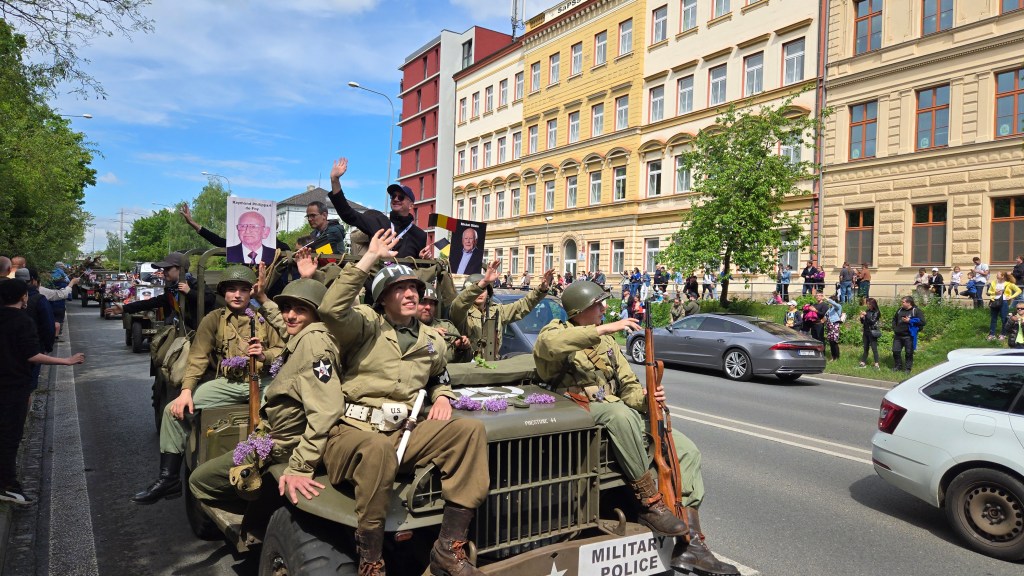
Boys from Belgium celebrate on behalf of their ancestors at Slavnosti svobody Enlightened with this new knowledge, and coupled with the fact that organizers seemed determined to make the big 8-0 the most special remembrance in the history of Liberation Day made for quite a memorable, and enjoyable experience.
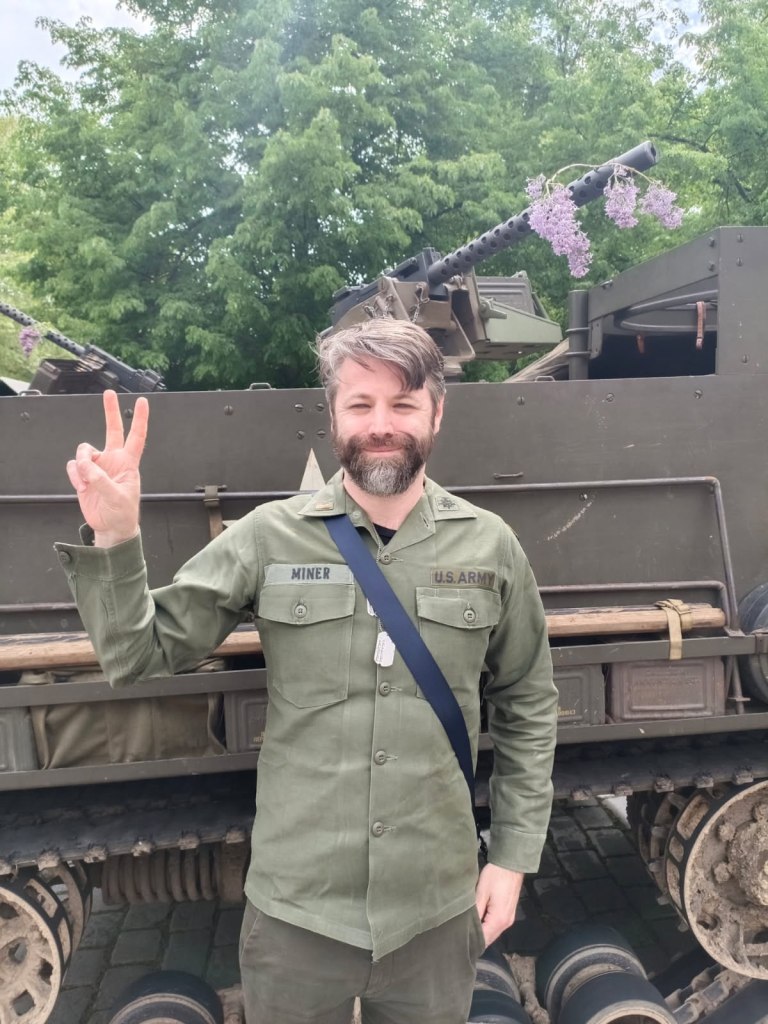
Oh yeah, and my father passed away on the ides of March this year. For him, I wore his officer’s dress shirt that day.
Petra and I left Prague early in the morning, as we wanted to ensure a good place to view the parade. We saw that the organizers had planned a different route, so we left the Plzeň’s Náměstí Republiky (Republic Square) to the city’s main thoroughfare, Sady Pětatřicátníků, just two blocks to the west. However, as soon we arrived, we saw that the entire four-lane boulevard was jam packed with other visitors. We checked the map again and thought we might get a better view further down along the root.
With this in mind, we turned north for a few hundred meters and then east, finally settling at the intersection of Veleslavinova and Rooseveltova streets. At least we thought we had finally settled. It was only a few minutes before the official start of the parade, and we were the only two people standing at the intersection. We asked a local police officer if we were indeed standing alongside the parade route. He informed us that while yes, this was technically part of the parade route, this wouldn’t be a particularly good place to watch from because the tanks were too large to travel this route!
Oh boy! So we walked north, down the hill, and finally settled near an underpass on Tyršova–another four-lane boulevard that runs east-west near the center of Plzeň. After so much frantic scurrying from place to place, it subsequently felt like an eternity before the parade ever reached us (in reality, is was only fifteen minutes). Nevertheless, it was the worth the wait!
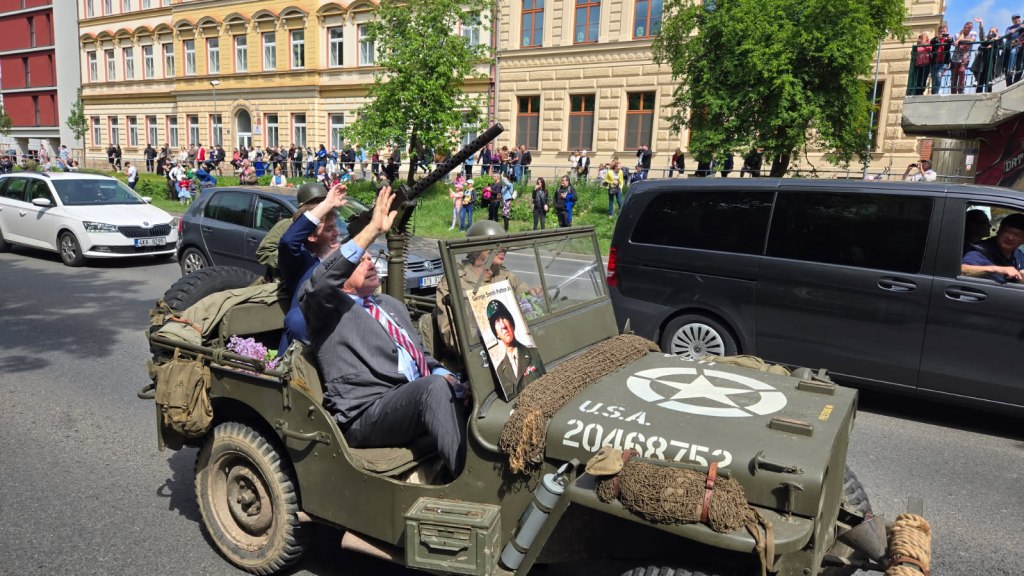
General George S. Patton’s son and grandson salute in unison George Patton’s Grandson and Great-Grandson led off the convoy, followed by the descendants of other officers and soldiers from Liberation Day. Not just Americans, but Belgians, Australians, and even some of the brave Czech resistance fighters were there with enthusiasm.
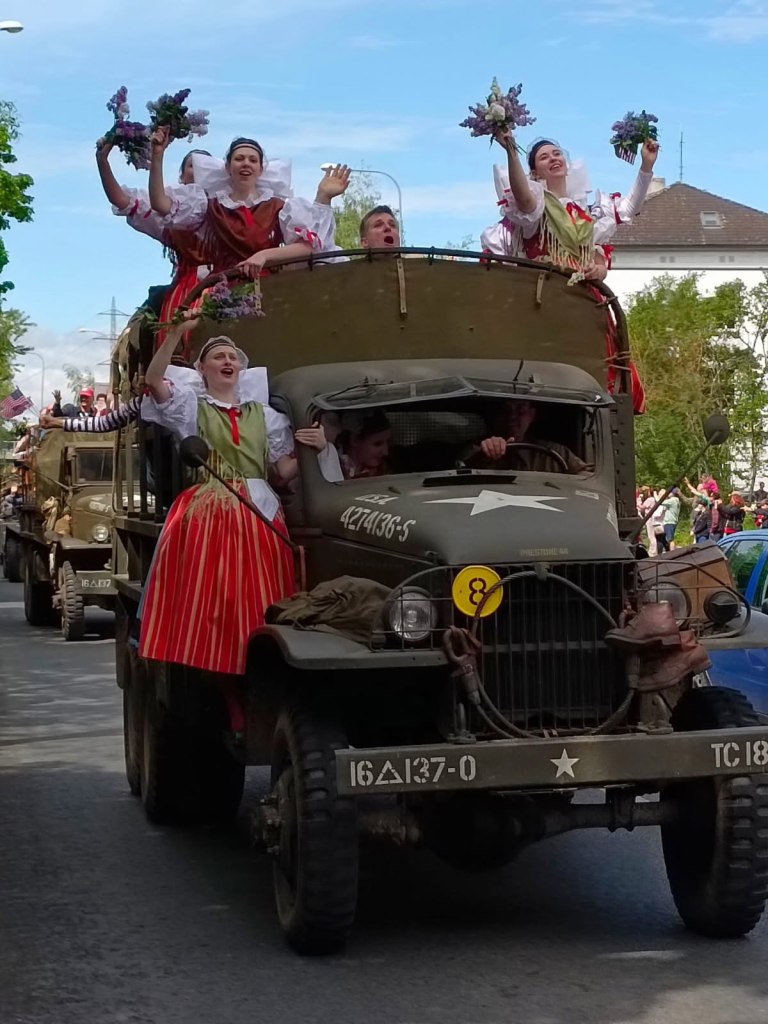
Maybe it was just me, but the overall vibe felt a little more festive, and a little more reflective. The parade itself was larger, the crowd was larger, and there were more supplementary activities before and after the parade to soak in the history. And of course, there were the tanks. Massive, massive authentic WWII US Army tanks.
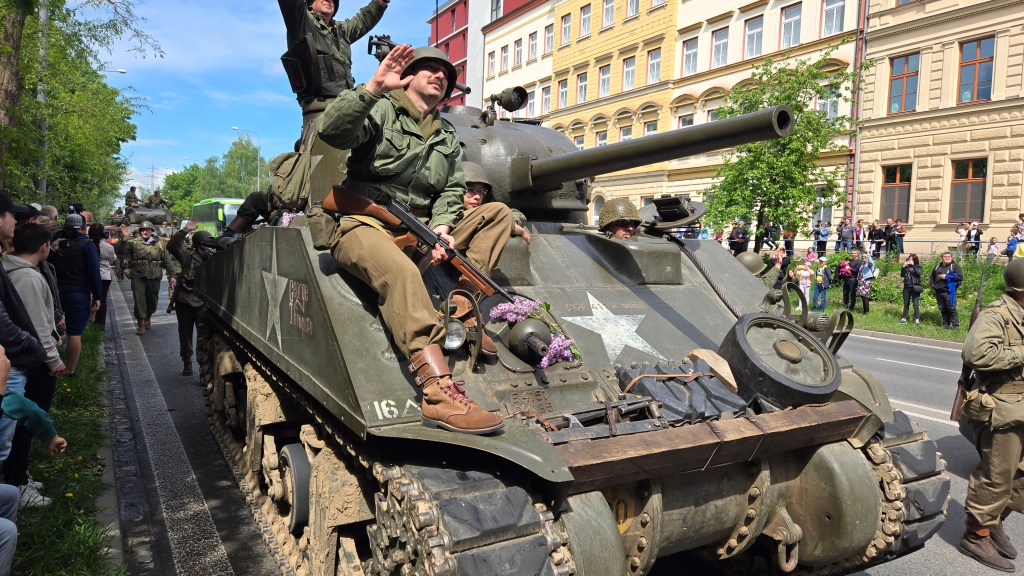
As we watched, some of the parade participants paid particularly close attention to my father’s uniform. Some saluted, some gave me a high-five. All of them smiled and waved. Those salutes are for you, Dad.
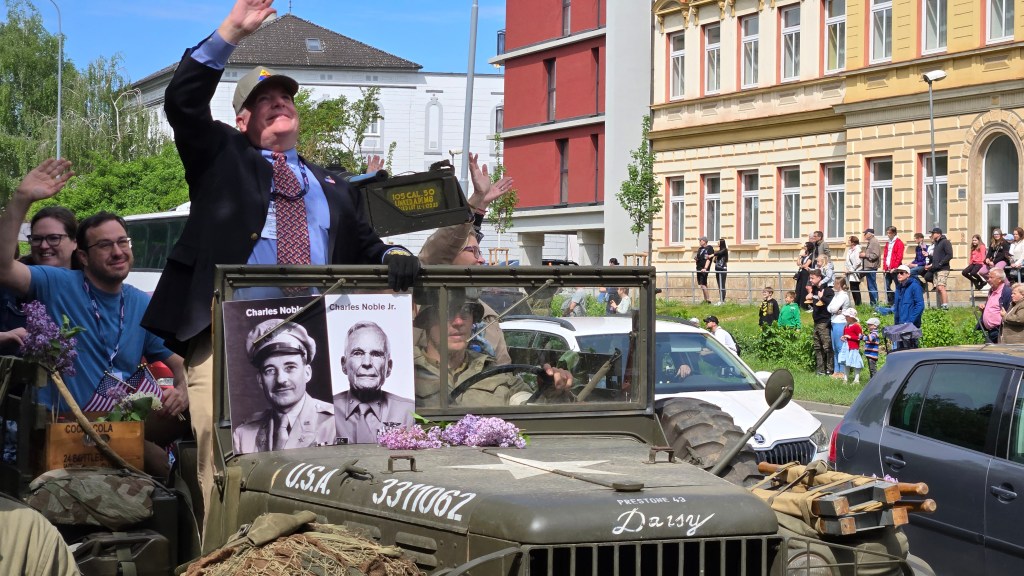
After the last of the parade convoy had departed, Petra and I headed back to Republic Square. As we were walking, we ended up joining with part of actual parade, as we were right back at the intersection of Veleslavinova and Rooseveltova. A few people saw my father’s uniform and thought I was part of the parade and took my photo. To be fair, I was wearing my grandfather’s dogtags. Speaking of my grandfather, here’s what I learned about John J. Donohue’s service during World War II.
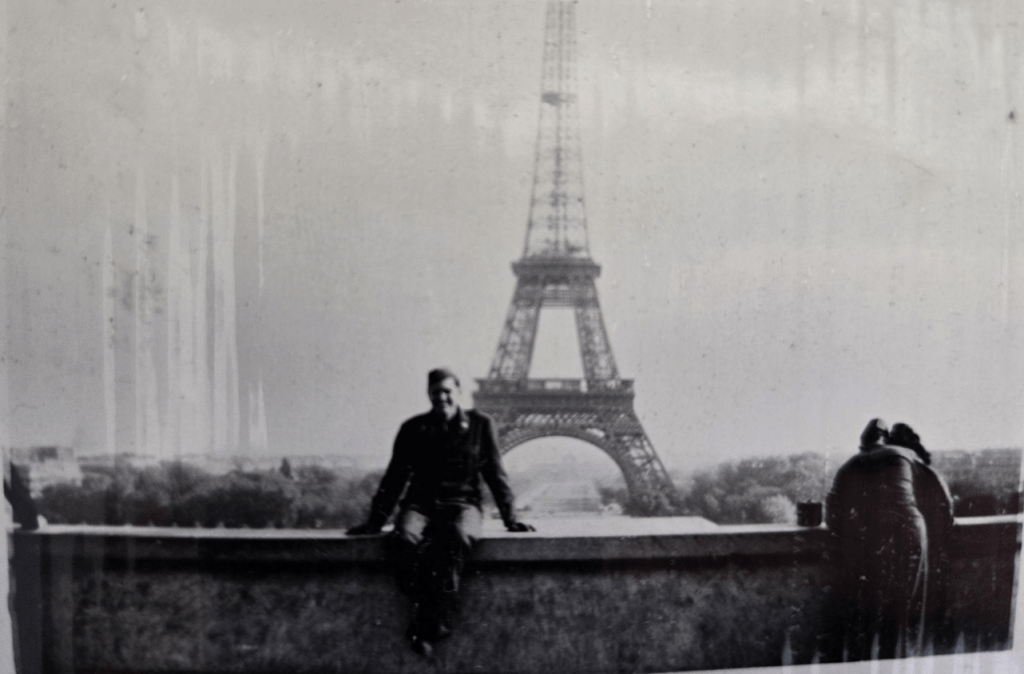
25 August, 1944: Sargent John Donohue enjoys a rare moment of peace during the liberation of Paris. Photo credit: Julius Tucker (probably) In the summer of 2008, about a year and half before he succumbed to father time, I finally asked my grandfather, “What exactly did you do in World War II?”
“Well . . .” he said, with a moment of hesitation, “I enlisted on December 8th, 1941.” He then went on to describe his time at the harbor defense of Monterey Bay California, his anticipated deployment to Anzio, his actual deployment to Normandy (“I was on a boat on June 6th, we didn’t land on the beech until the following day), his participation in the Battle of the Bulge, the difficulty in the crossing of the Rhine River, and finally, his near court-martial on 2nd of May, 1945, for going to a local dance hall and dancing the night away with the local German women. The charge was fraternization with the enemy. His defense, “everyone else was doing it!” won him reprieve from his commanding officer. As it was, the town of Germany they were in surrendered a few hours after the dance party was over, and all was forgiven.
Still, I wondered, where was he two days later? Did he and his men keep marching on to Plzeň? The photo I found in the family archives put that question to rest. General Patton commanded the US 5th Army, and it was men under his command that officially liberated Plzeň. Sargent Donohue was in the 4th Army, commanded by General Raymond “Tubby” Barton, which landed on Utah Beech on June 6th and liberated Paris August 25th. In the final days of the war, they were in southern Bavaria. The troop movements of the US 4th Army during WWII align with my grandfather’s story exactly.
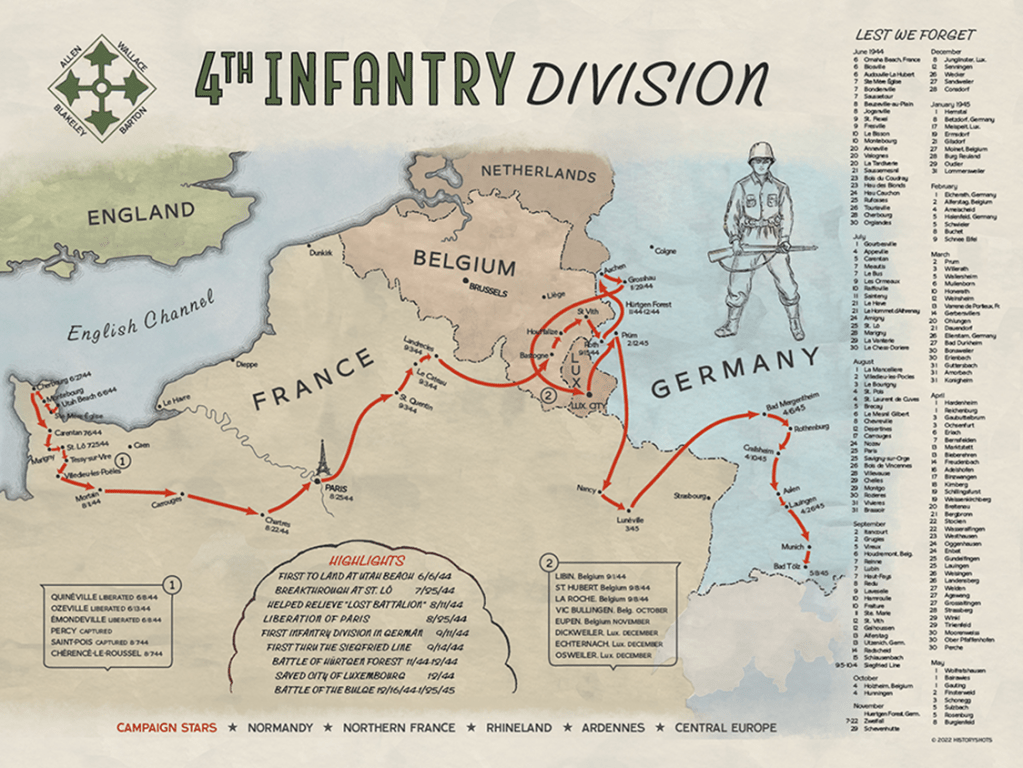
Since four isn’t five, it’s impossible for him to have been in Plzeň on May 6th, 1945. But as grandpa liked to say, “who’s counting?” So yeah, Grandpa, those photos are for you.
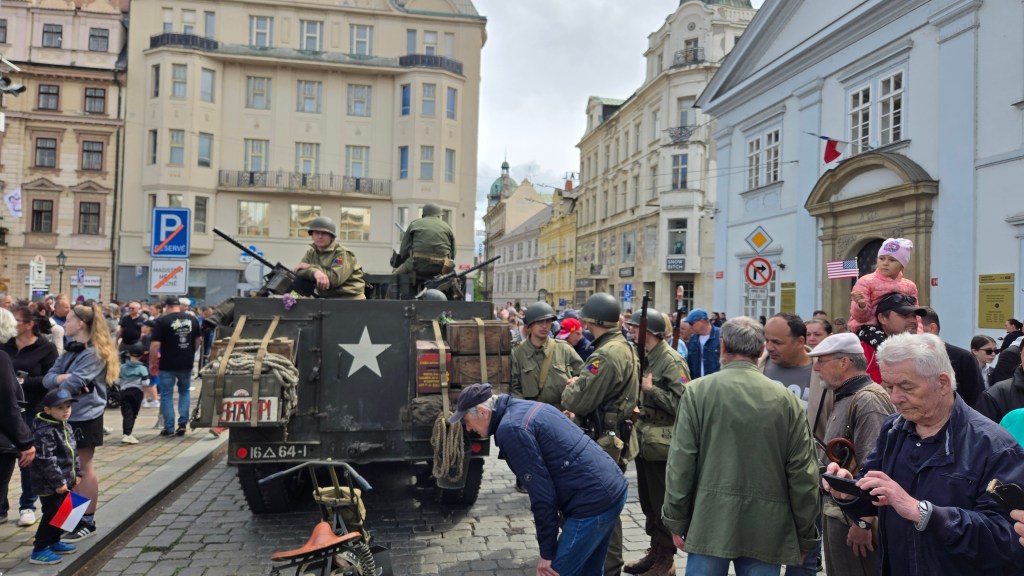
After the parade, we stayed for another few hours, visited some of the exhibitions, watched a concert where people sang Bob Dylan’s “Love Minus Zero No Limit” in Czech, and finally enjoyed a tasty treat with cappuccino before heading back to Prague. This closed another fascinating chapter in the land of King Wenceslas.
As for next year, who knows? Maybe we will be in Paris 😉
-
Ice and Fire: Prague Between Seasons
Mid-April is an interesting time in Central Bohemia. And by “interesting,” I mean it is uncanny how virtually every element of the weather is identical to my native New England.
Cold, snow winters. Hot, humid summers. A refreshing autumn after the oppressive summer heat. And while spring is a welcome change from the seemingly eternal darkness and brutally bitter winter weather, Prague denizens are somehow caught in a weather limbo. In mid-April, it’s still too cold for t-shirts, and not yet hot enough to ditch even a light jacket. Thus, it’s either wear a jacket and sweat or brace the mild chill and put on a jacket anyway. Maybe that’s why Czechs, like many New Englanders, frequently complain about the weather: No matter the season, there’s a always a reason for some sort of discomfort.
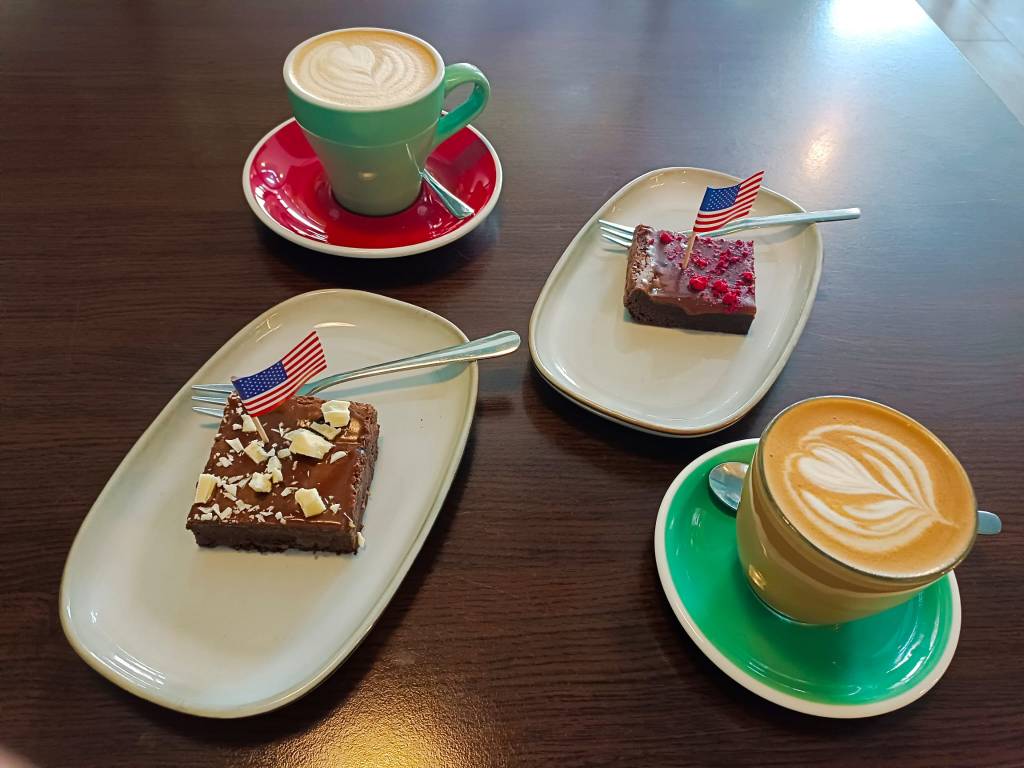
And yet this is incongruous ever-changing weather sometimes leaves its mark–if only for a few hours. One such example was December 28th, 2024. T’was a few days after Christmas and all around Prague, the air was so cold and moist that all one could see was a cloud of ice fog.
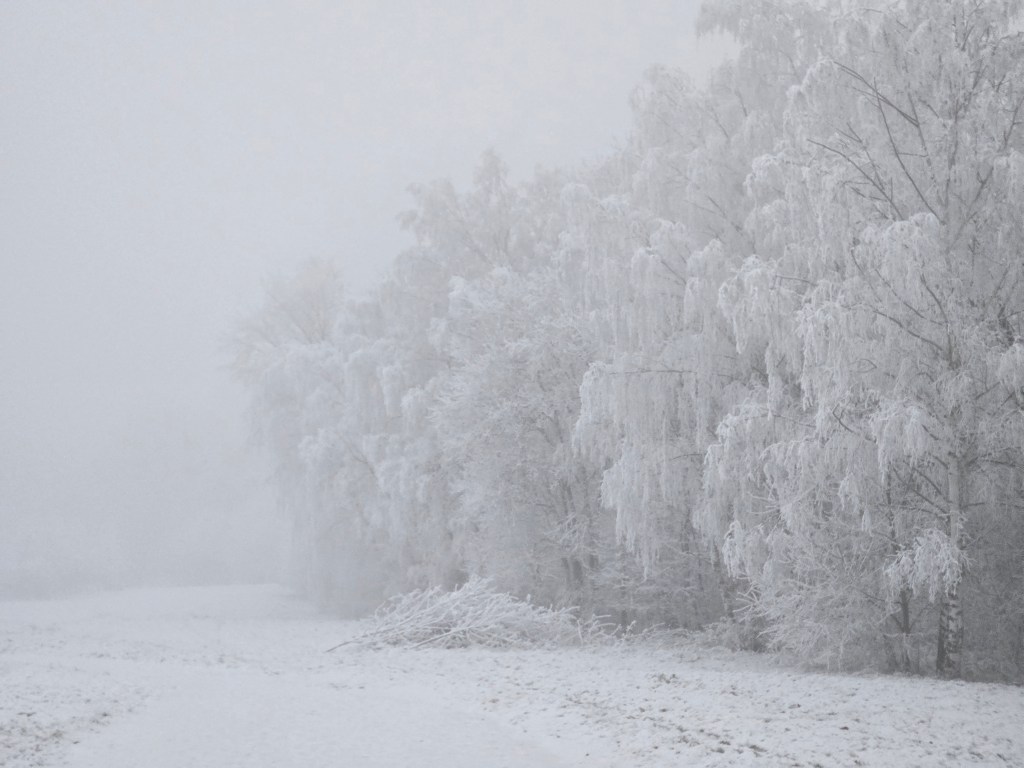
Ice encapsulates everything in sight on this footpath near Břevnov Monastery To a casual observer, it looked like snow was all around, yet ice was everywhere, from the tops of the trees to the grass on the ground.
A few people from Prague braved the cold air, as the previous Christmas without snow was totally unfair. To see such a sight reminded one of years long ago, when every Christmas covered all of Bohemia in pristine white snow.
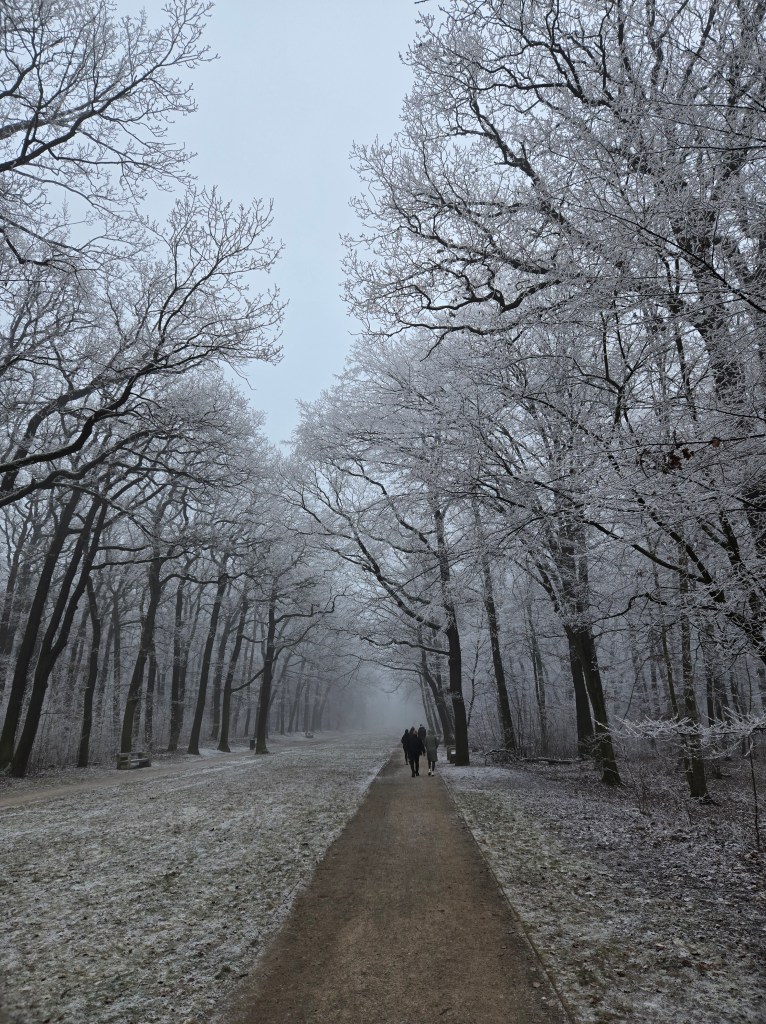
A few brave Praguers venture out into the cold paths of Obora Hvězda As we walked through the footpaths on the outskirts of the city, and admired the view so unique and so pretty; we couldn’t help but think that perhaps all this was a sign: Christmas without snow is a capital crime. And although this snowless Christmas didn’t result in any tears, it left us all hopeful that we’d enjoy better luck next year.
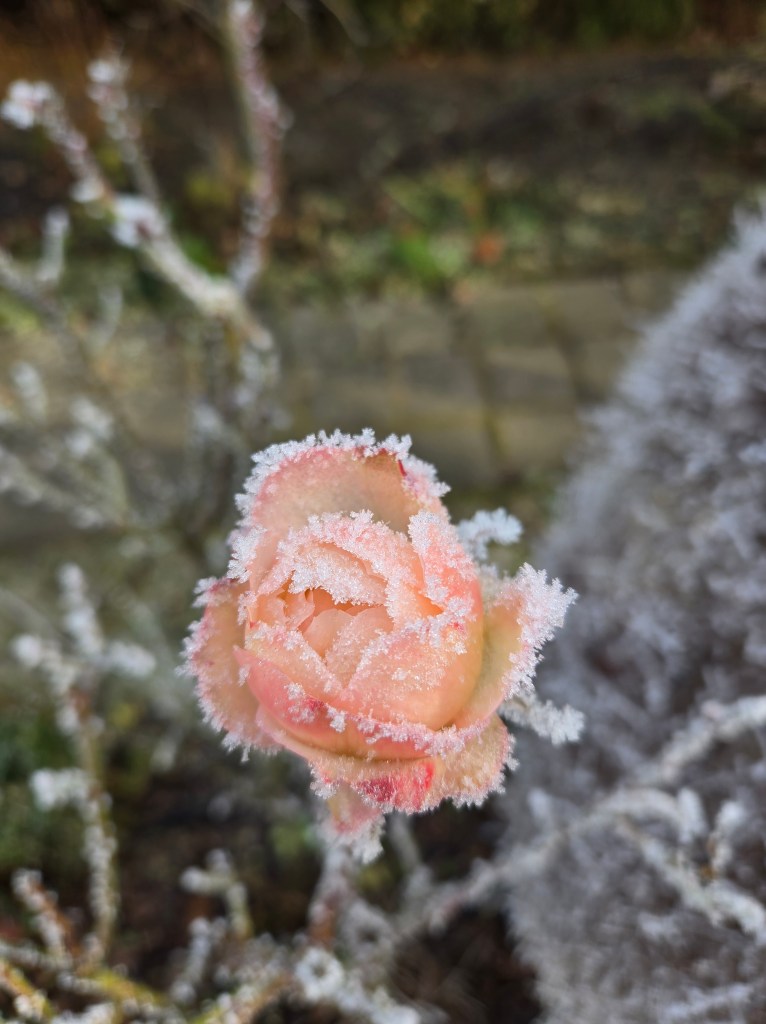
Mother nature wraps a rose in a coat of ice to foreshadow warmer days ahead The summer heat, as many people reckon, is just as oppressive from a different direction. Here’s an amusing story from July 2022, when I needed escape from the heat island known as Holešovice (yes, I know it’s not literally an island, just a figure of speech for the scorching hot peninsula). Some locals had recommended that I make a day trip to Český Krumlov. This small town is a little over an hour away by bus, and sits just north of the Austrian border. I made a reservation at one of the local hotels, and set of for what I thought would be a relatively quick and painless procedure that would take my to this historic, picturesque village. Boy, was I wrong!
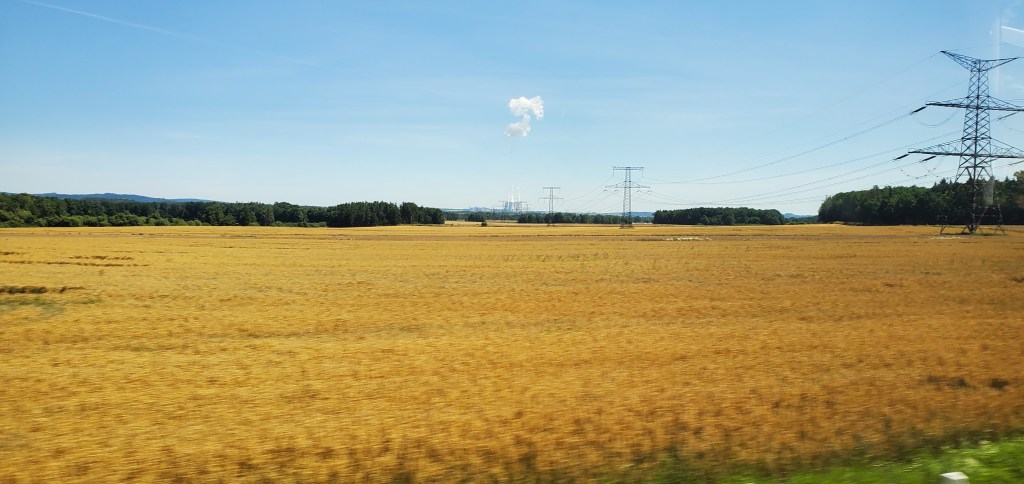
The scorching heat bakes the fields of wheat just south of Prague The bus ride itself was fine — until I arrived. The driver spoke to two American tourists as they stepped off the bus. I didn’t catch all of their conversation, but I distinctly heard the driver say, “the other bus stop is closer.” I wasn’t entirely sure if this was my stop, but I tried to get up from my seat and exit the bus anyway, since it seemed like I was close enough to my destination.
However, this simple feat proved impossible. The woman who was sitting next to me looked startled beyond belief when I tried to get up. “My stop,” I said. When I spoke to her, she looked utterly horrified. It wasn’t just a language barrier that was a problem–it seemed totally beyond her comprehension that someone would actually get off the bus at a popular tourist destination. No matter, I thought. The next stop is closer, right? Maybe those American tourists just wanted to go for a scenic walk on their way to Český Krumlov, right?
Wrong. My hopes quickly evaporated as the bus traversed along a mountainous rural road with no human structures in sight. To be fair, the evergreen trees that enveloped the landscape were very pretty, but I was in a bind. I really had no idea where this bus was going or how I would get back to Český Krumlov. And my Czech at this point was so nascent that I wasn’t really sure how I could communicate anything effectively to the person sitting next to me. Suddenly, I remember the magic word (or a magic word) “prominte” from my Duolingo lessons (this roughly translates to: me, you excuse please. Ironically, the word “perdon” means the exact same thing in Czech as it does in English. Obvously, I didn’t know that then. Oopsie).
Anyhow, after about twenty minutes, the bus pulled off the main road and made it’s way into a very small village that had about ten houses situated on each side of the one road of said small village. I looked right at the woman next to me and just said, “Prominte!” She finally got it that I needed to exit the bus, and exit I did. Once I stepped off the bus, I checked my phone to see if I still had reception in the remote mountain town. Sure enough, I did. Success!
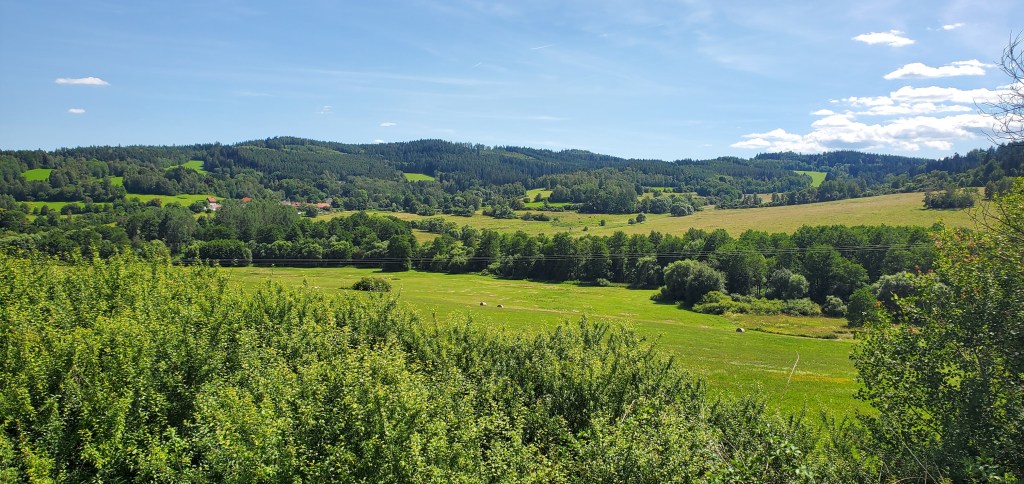
10 miles of this magnificent view was a bit more than I bargained for My elation was short lived; however, as I quickly searched to see when the next bus would arrive in the opposite direction to take me back to Český Krumlov, only to find out that wouldn’t arrive until the next morning. I also had just enough service to discover that it was exactly ten miles (or 16 kilometers) to my original destination. I resisted the urge to scream into the wilderness and commenced walking. Hey, at least it was downhill!
I honestly can’t remember how long it took for me to walk, but I do remember that I was an absolute bucket of sweat by the time I finally arrived at my hotel. I quickly asked the receptionist if I could stay for an extra night and was relieved beyond words when he answered in the affirmative.
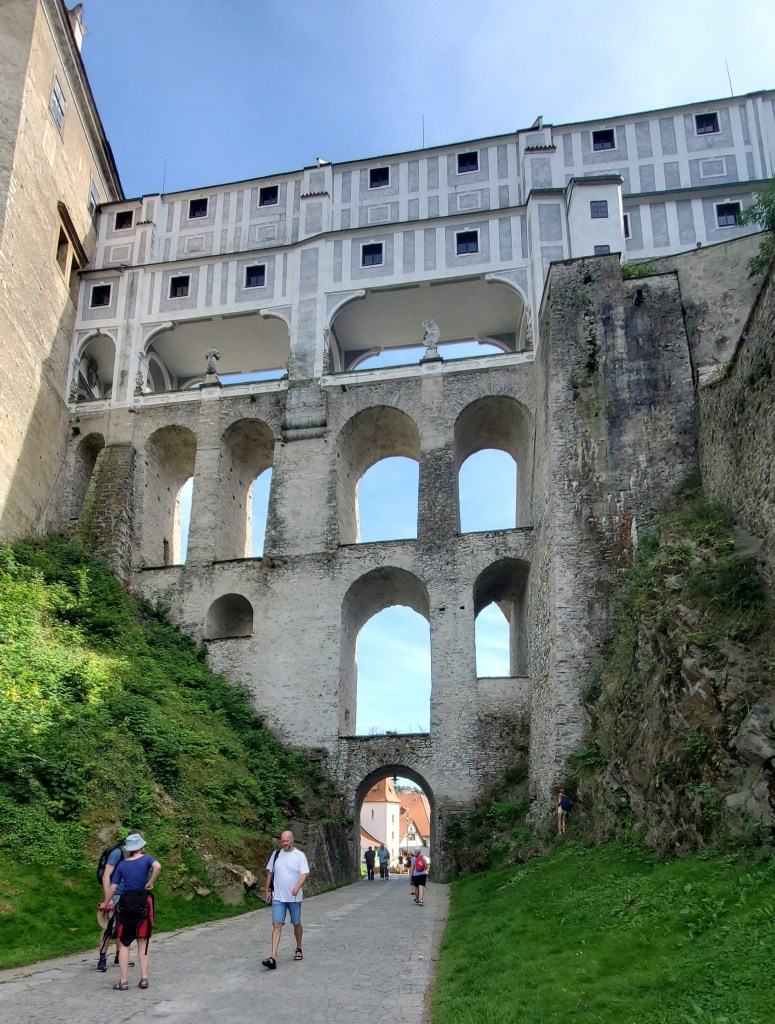
A unique entrance to the UNESCO heritage site that lies within . . . Once acclimated, I walked up the stairs to my room for the next two nights. The cool mountain air swept in through an open window. I took a few deep breaths, and let out a long sigh of relief. I had two days Český Krumlov to look forward to.
Thank god I paid for the second night.
But that is a story for another time . . .
-
Liberation Day!
Dateline: 5 May, 2024
What an event. What an experience. What a day.
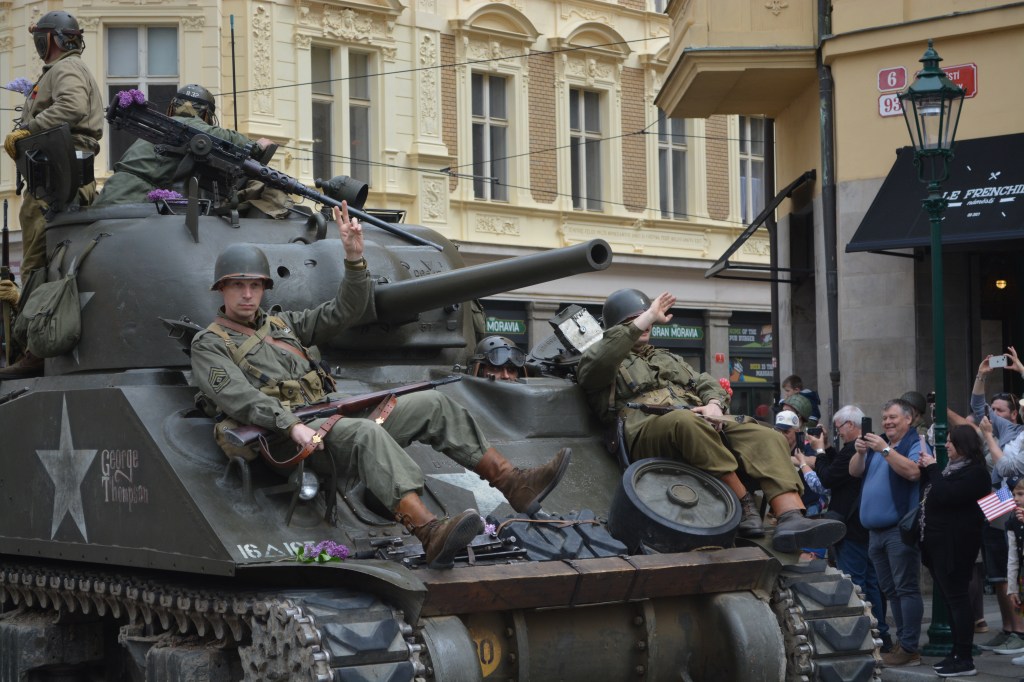
An authentic WWII US Army tank leads the way through PIlsen’s Republic Square, to the delight of joyous onlookers
The 8th of May is a national holiday in the Czech Republic, as that was the day that Germany officially surrendered to the Allied Forces, effectively ending World War II in Europe. However, residents of Pilsen celebrate with grandeur on the 6th of May, with WWII re-enactors as well as descendants of Allied veterans, who drive authentic WWII era vehicles through the center of PIlsen. People also celebrate with music, speeches, and copious consumption of one of their favorite American imports: ice cream. It’s a big deal.
You might wonder, why Pilsen? And why two days early? It’s a good question, and the answer illustrates one of the few hidden chapters of World War II.
Those who know their World War II history know that Czechoslovakia was on the other side of the Iron Curtain, and its true that most of the country was “liberated” by the Soviet Union. However, people often forget that Prague, the capital of this Slavic nation, is actually west of Vienna. And even those who know the name of legendary General George S. Patton are unaware that he actually advanced his forces clear past Germany and into Western Bohemia.
Here’s a little background: The City of Pilsen, better known among Americans for the beer which bears its name, is located in Western Bohemia, midway between the German border and the capital city of Prague. During World War II, it was home to a major weapons factory. It was vital to the Nazi war effort, as Bohemia was out of range from Allied Bombers–at least until the 25th of April, 1945. That day, American B-17 liberators bombed the factory into oblivion. The following day, P-51 mustangs with their massive .50 caliber mounted machine guns mangled the railways beyond function. Thus, the occupying German force had no means of reinforcements, and were effectively trapped. Patton pounced, and after nearly two weeks of heavy fighting, the Nazi-appointed mayor of Pilsen surrendered the city, and Pilsen residents were able to celebrate their freedom two days before the rest of Czechoslovakia.
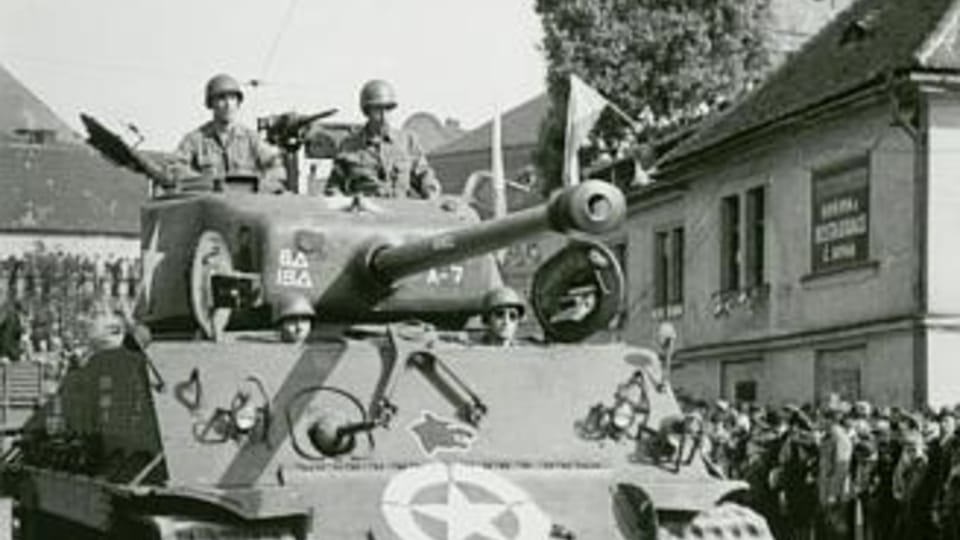
Soldiers from General Patton’s 5th US Army Brigade greet the crowd on their liberation ride through Pilsen, 6 May 1945
Patton didn’t want to stop there, and formally requested permission from Dwight Eisenhower to advance all the way to Prague. Eisenhower, ever the diplomat, declined. “I will not an endorse a strategy that is militarily unwise to gain a political advantage,” wrote Eisenhower to Patton. Even as Eisenhower wrote the letter, Prague resistance fighters attempted to liberate the city on their own the following day, to no success. The day after that was V-E Day, and Soviet tanks rolled into Prague unopposed, as Germany had already surrendered.
Unbeknownst to Patton, Eisenhower’s decision came from above. Months prior to V-E Day, and even before the Yalta Conference, Winston Churchill and Josef Stalin reached the “percentages agreement,” by which the Soviet Union would occupy all the Slavic nations as well as East Germany, while the British and the Americans would be tasked with the occupation of rest of formerly Nazi-occupied Europe. The people of Czechoslavkia , Pilsen in particular, were pawns in this game, and although American forces initially worked to rebuild the damage that they had incurred in Pilsen, they left a few months later.
This ended a chapter that the opposing sides of the Cold War consciously chose to forget. Josef Stalin wanted to be seen as a “hero” to the Slavic people, and any mention of America’s role in the liberation of Western Bohemia was deliberately omitted from “official history.” Winston Churchill was obsessed with blaming Stalin for the creation of the “Iron Curtain” that he himself helped design, and Americans would rather not remember how little leverage they had in crafting postwar Europe, nor would they like to remember any fissures between Roosevelt and Churchill. And so for nearly half a century, this little chapter in World War II history was simply overlooked.
But the people of Pillsen never forgot. And as soon as the Iron Curtain finally fell, residents of Pilsen commenced what has become an annual tradition: Liberation Festival. From Friday, 3 May to Monday 6 May, celebration is a mix of the somber and the euphoric. 79 years after the actual Liberation Day, few people are alive to remember the original, but their children and grandchildren come to reflect and remember. And as the grandson of World War II Veteran who witnessed the parade on Sunday, I have to say it is a very moving experience.
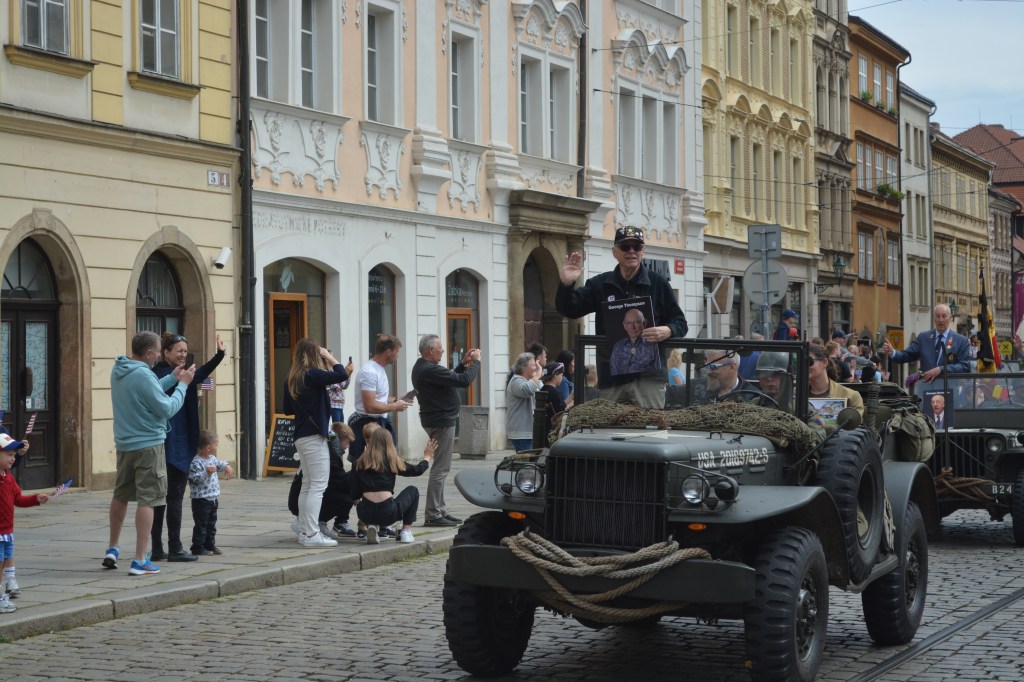
I wore my grandfather’s dogtags and traveled to Pilsen with Petra, We enjoyed some American style grilled sandwiches and lemonade before the parade, then stood and cheered with everyone else in attendance for the big show.
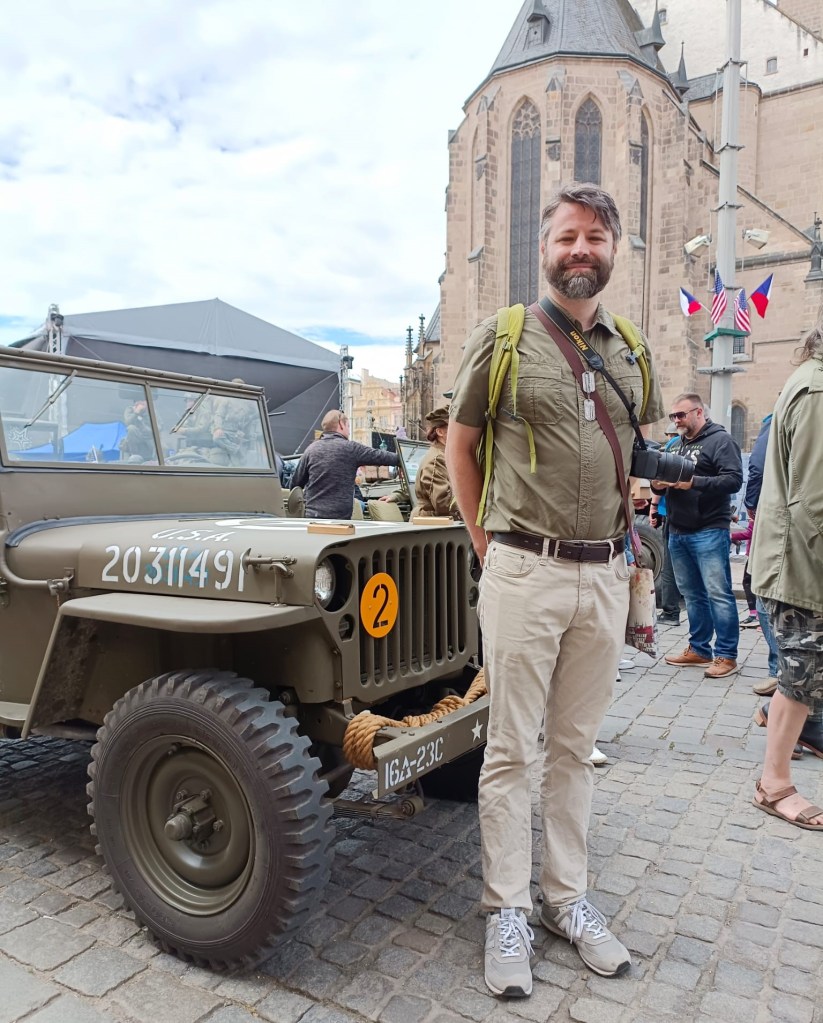
Mere words will never be enough to sum up the magnitude of gratitude for this experience
Having grown up in a country that prides itself in high standards, then seeing said country repeatedly fail to live up to such standards can be rather depressing. Hell, just a read any book by WWII Kurt Vonnegut and you’ll understand. But the way that the descendants of this historical event keep this memory alive, as well as the gratitude shown by the people of Pilsen is something that simply quite uplifting.
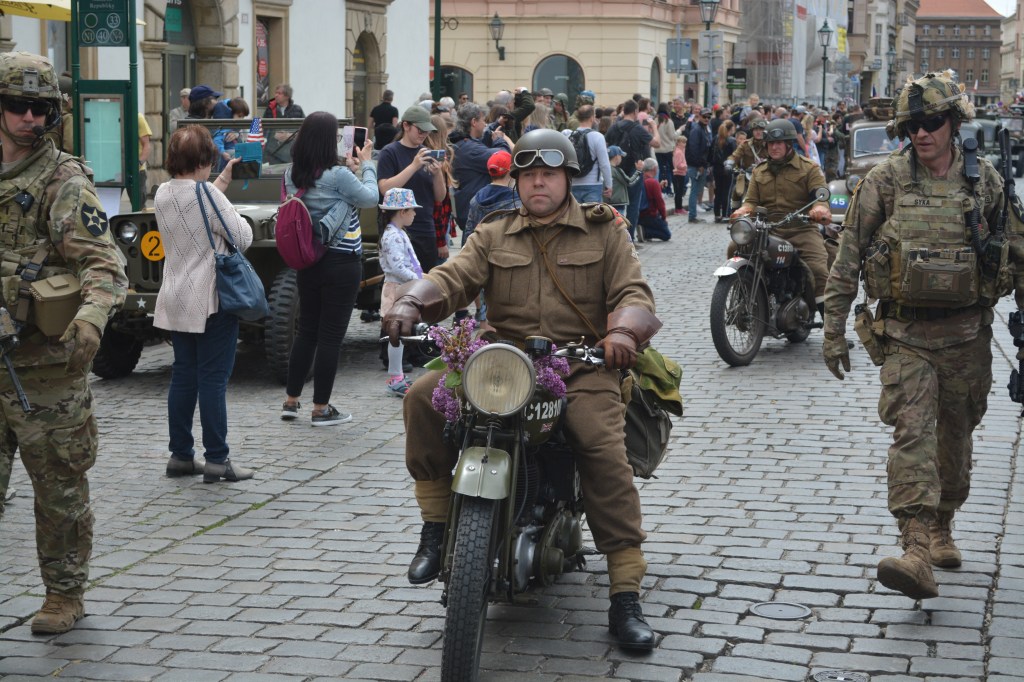
The old and the new: Czech soldiers equipped with their modern uniforms can’t help but admire the classic look
The parade was a sight to see, to put it mildly. I snapped more than my share of photos, and clapped especially hard for the descendants of the veterans who traveled halfway around the world for this little celebration. And when the parade was over, I even had a chance to experience some of the hardware first hand. Yes, for the low price of only 200 Czech Koruna one could sit in the actual cockpit of an exact replica of British Spitfire.
“Are you sure you want to do this?” asked Petra. “200 Crowns is a lot of money for such an experience.”
“True, but I’m an American, we love this gimmicky stuff,” I replied enthusiastically. “Besides, it’s only about 8 dollars!” I invited Petra to sit in the take a chance in the cockpit, but she declined anyway. Although she got quite a kick out of seeing me get ready to take off and do a celebratory city flyover.
Actually, it’s closer $8.50, but as my grandfather liked to say, “who’s counting?” The experience was quite valuable. Once I sat in the cockpit, I felt that flying in such a plane over the English Channel, even without dodging enemy fire, would basically be suicide. Nothing makes you feel more respect for the R.A.F. than feeling the flight controls and seeing the spartan instrumentation panel of this winged weaponry.
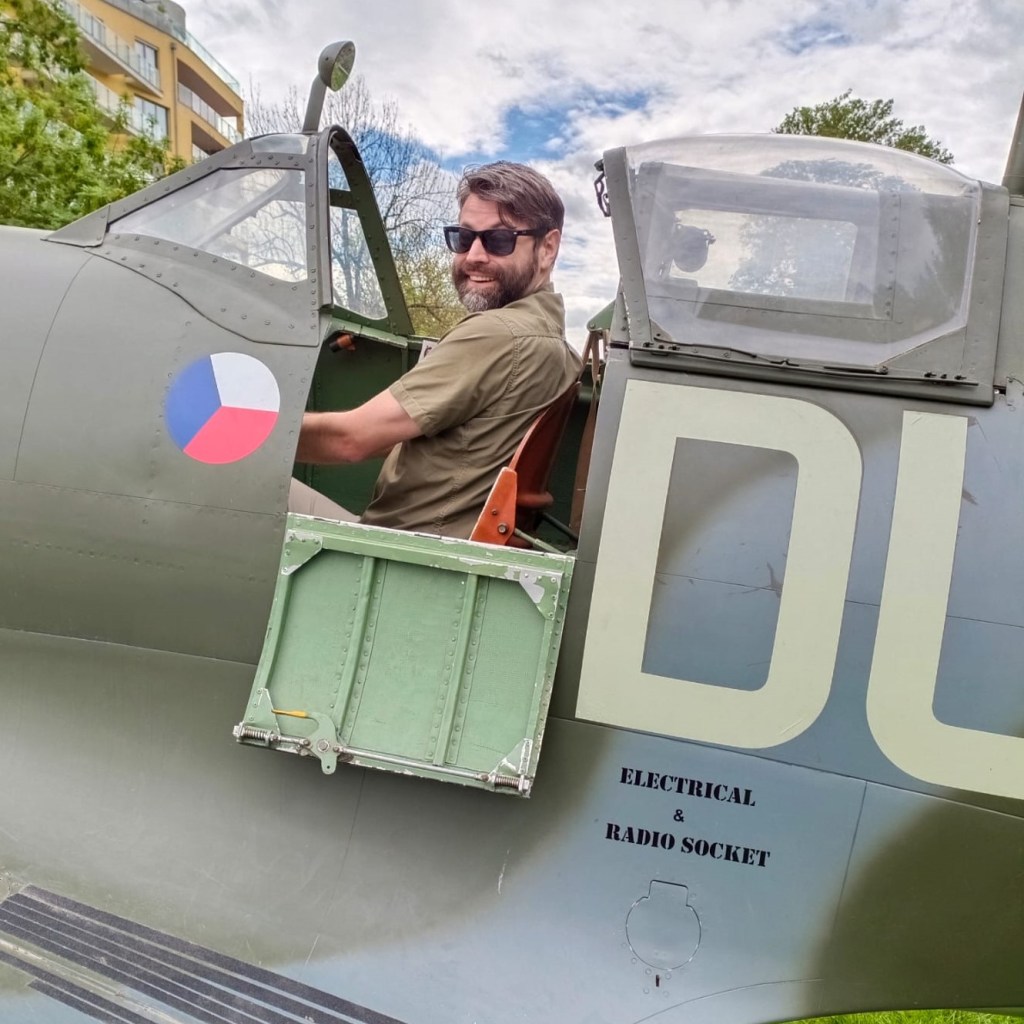
Are you ready to fly over the English channel in this one-man fighter plane? Yeah, me neither.
After my moment in the pilot’s seat, Petra decided to indulge in another way to celebrate America’s liberation of Pilsen: ice cream! We looked at some other exhibits, saw some celebratory musical performances, and then finally made our way to George S. Patton museum to get as much historical context as possible.
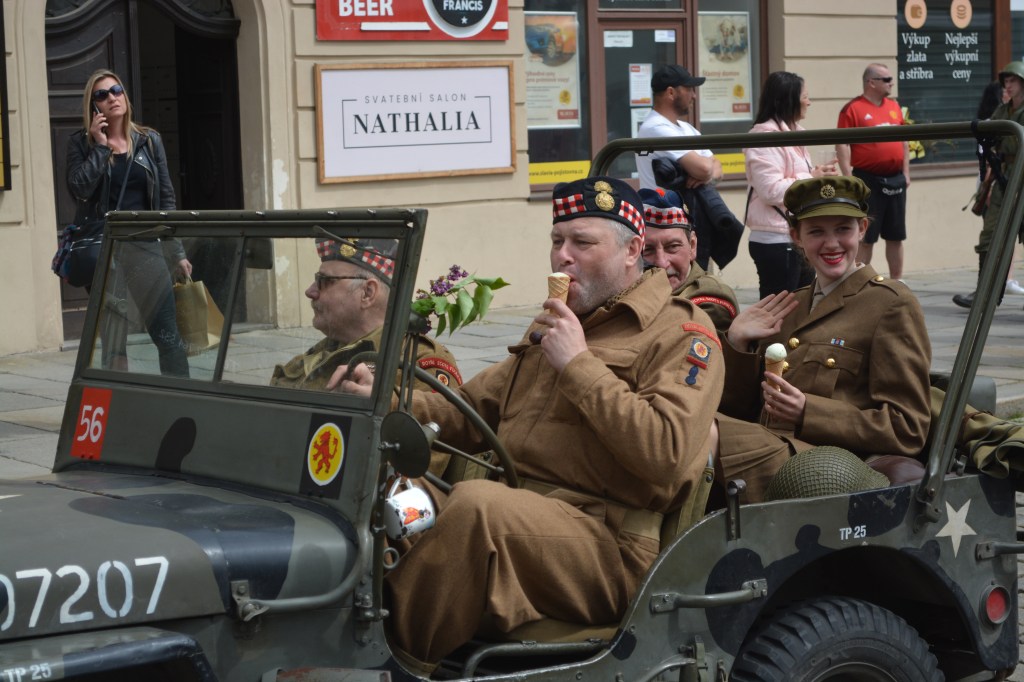
I scream, you scream. We all scream for ice cream!
By late afternoon, it was time to head back Prague. As we were leaving, it was if we got to the see the parade all over again. Obviously, we weren’t the only one’s leaving town.
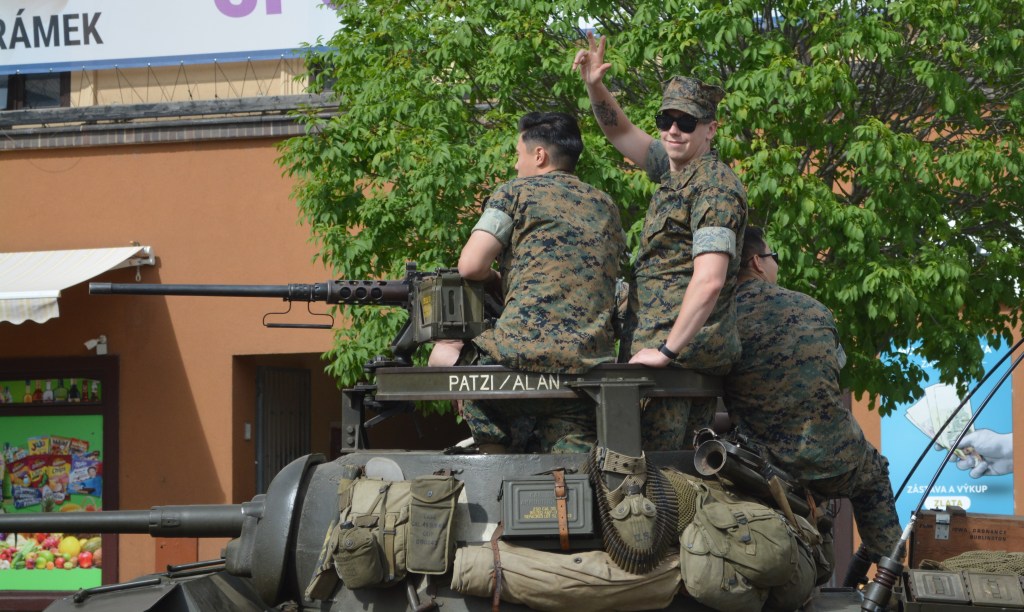
Ahoj!
And with that, we waved our final goodbye–or was it hello? After all, “Ahoj,” like Aloha, means both hello and goodbye. And we will certainly return to Pilsen for the 80th Anniversary of Liberation Day next year.
-
One Year Prague-a-versary
Dateline, July 2, 2023
One year. One year since connecting flight from Dublin landed at Havel international airport. One year since I first set foot on the mainland of the European Continent. One year since this great adventure began.
I celebrated with a very casual afternoon at the Letná Beer Garden.. As I purchased my drinks, I reflected on how at first I fumbled through what little Czech I knew to order a beer (for example, saying ‘jeden pivo’ rather than ‘jedno pivo’) to order a beer, or getting the grammar right but the context completely wrong (saying ‘půl litre’ rather than simply ‘velké’), and how with authentic practice, I can now make such a maneuver with ease. Hey, I may not have mastered the seven Czech grammatical cases, but at least I can speak enough Czech to feed myself!
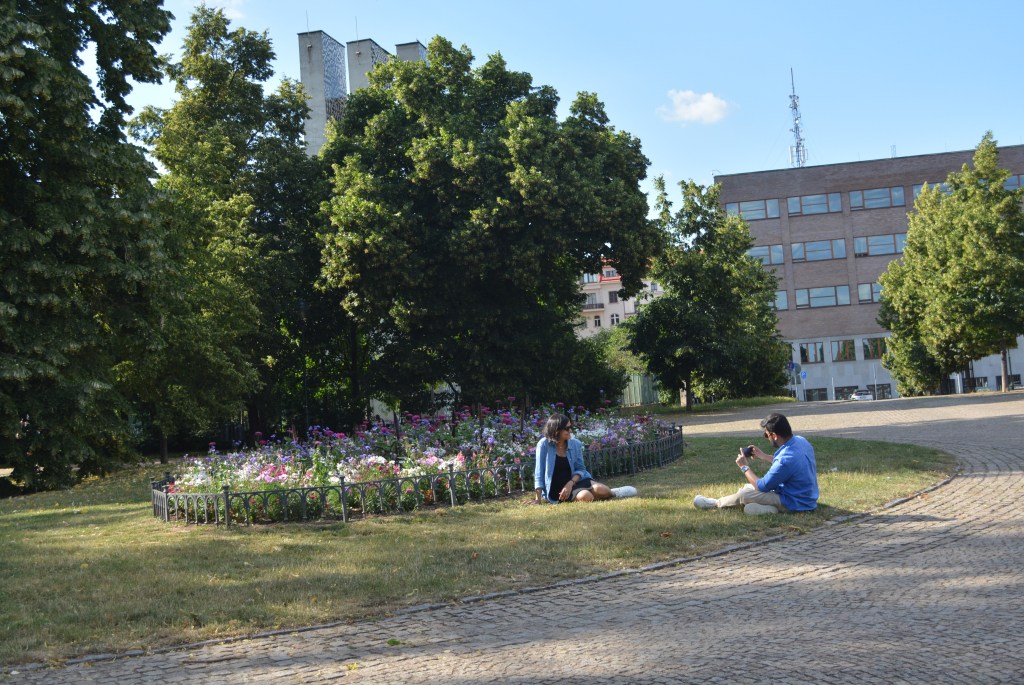
Prague tourists pose for the pose for the perfect photo in Letná Garden I also thought about going back to my favorite restaurant, but in a way that may seem counter-intuitive, I decided against it. I was surrounded by tourists in Letná who were snapping selfies and not even attempting to speak any amount of Czech. I felt almost outside of the experience, as if on the outside looking in. I wanted to something to reflect that I was a traveler and not a tourist.Thus, I decided that I want to celebrate in a way that would make me feel like I was of Prague rather than simply in Prague. So, since it was Sunday evening, I decided to head back to flat in Břevnov, and make a nice meal for myself.
I headed back towards Brevnov, but took time to enjoy a nice scenic walk through the shade of Lentá park’s many trees, rather then head out to the urban jungle of brick and concrete. The crowd was a little more mixed and I walked forward, and the collection of towards blended towards a mix of locals and foreigners by the time I reached the metronome.
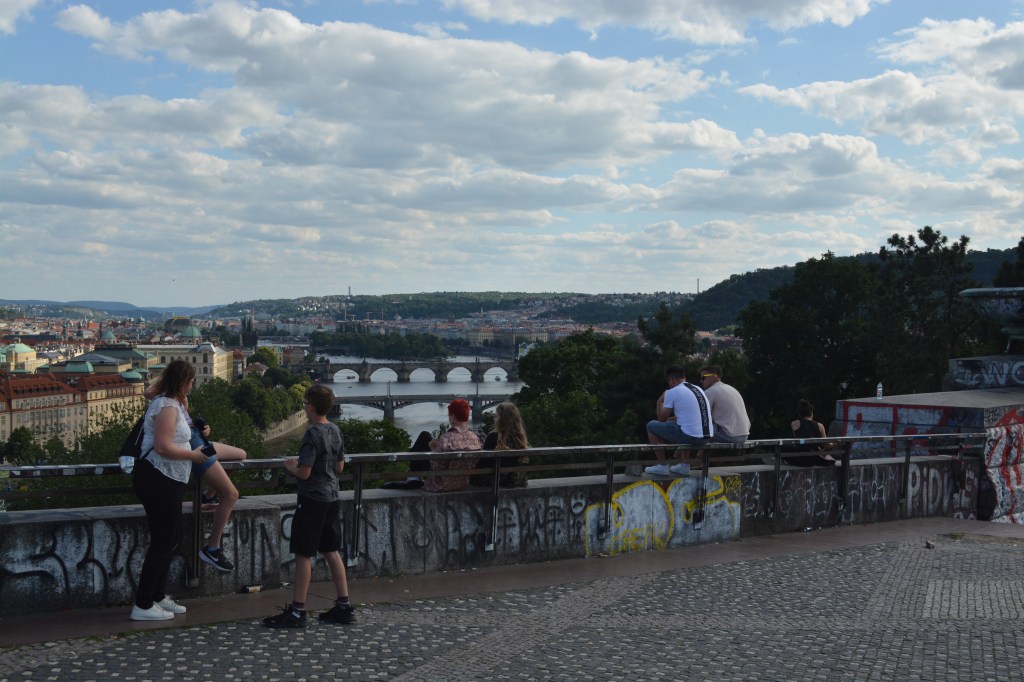
Locals and tourists alike enjoy the view from the Prague Metronome I continued further towards the Letna Park’s western edge on my way to the tram when I saw a dog swimming in Letenské jezírko. Optimistically known officially as “Letenské Lake,” it’s really a small pond, man-made at that, and manicured to perfection to serve as a mildly majestic gateway to the park for those traveling by way east from Prague Castle. Quite beautiful, but no lake. Part of me wanted to hope in the water and swim with dog, but I knew I would have plenty of chances for swimming in more suitable waters at a later date.
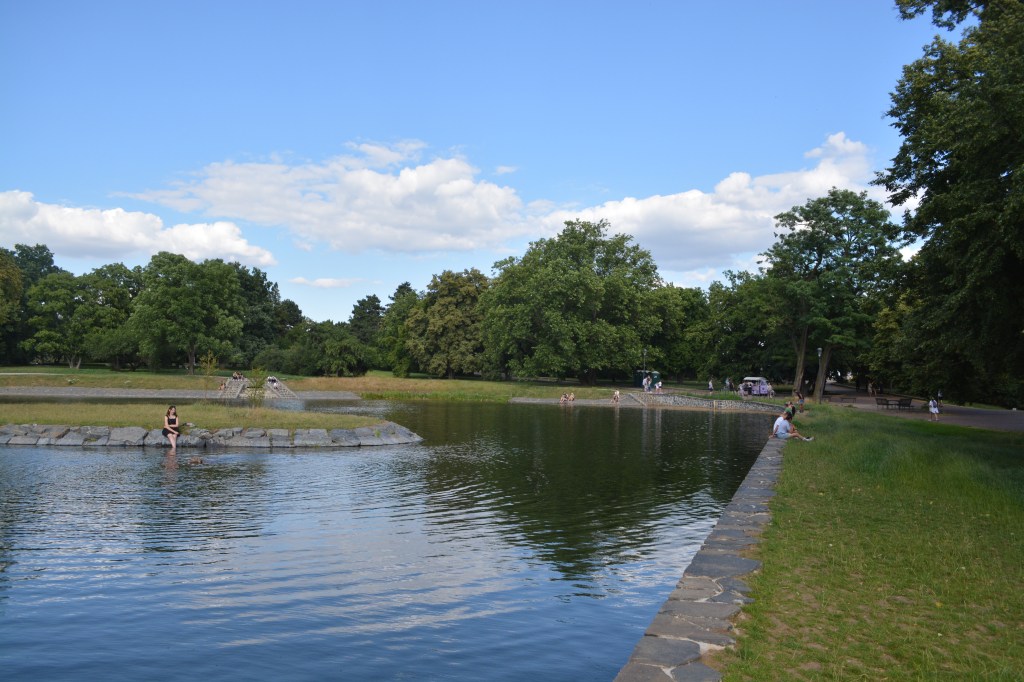
The watery western gateway to Letná greets visitors upon entry to the park Once home, I cooked one of my favorite meals, lemon chickpea broccoli pasta, and sat down with a nice bottle of Budvar, a.k.a. the real Budweiser. Unlike the fermented rice water that naïve Americans know as “the king of Beers,” this bohemian brew has the name that American merchants stole for marketing purchases but the actual taste to make it worthy of a crown. Drink one of these, and you will better understand and appreciate the phrase, “na zdraví” before sipping on fermented spring water from the mountains of southern Bohemia.

Na Zdraví! The author toasts to the first anniversary of his arrival in Prague When I looked at my photo, I noticed that my sunblock-soaked hands had left quite a mark around my shirt-collar. Oh dear, good thing I’m pitching in the major leagues in this photo! Anyhow, it’s an reflection of my attempt to stop my Irish skin from frying in the Bohemian summer sun–of which I will be seeing plenty in the days and weeks to come.
Tomorrow is a new day . . .
-
Forever Amy Concert Review
Dateline, July 16, 2022
Some people in this world are great singers. Others are great songwriters. And some are very good singers and songwriters.
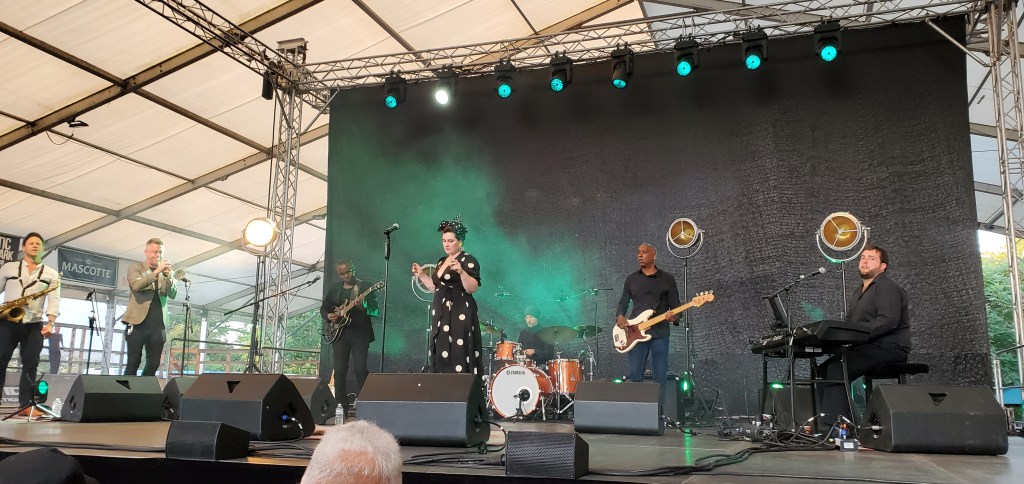
Singer Bronte Shande takes center stage with Amy Winehouse’s backing band Amy Winehouse was one such person. There are very few people in this world who have the gift of matching music to words. Paul McCartney has it, Carole King has it, and Amy Winehouse had it. However, McCartney and King did their best work as part of a duo, whereas Amy’s lyrical and musical genius seemed to reside entirely within her amazingly complex soul. Although it is certainly sad that she was taken from us too soon, Forever Amy rises like a phoenix from the ashes, so that her immortal music may live in. Featuring Amy’s musical director/bassist Dale Davis, Amy’s guitarist Hawi Gondwe, Amy’s drummer Nathan Allen, and Amy’s horn section of Henry Collins (trumpet) and Jim Hunt (saxophone), there is no doubt about the authenticity of the music. Bristol native Bronte Shande sings Amy’s immortal words, and while Shande may not be blessed with the same extremely think vocal chords that Amy possessed, but she sings pitch perfect and with the the same passion and intensity that Amy had. The fact that two women share the same working-class English accent is an added bonus.
And lucky me. As soon as I saw the poster for the Forever Amy show, I purchased a ticket. The concert venue took place at Mystic Skatepark, a small platform with bleachers on the eastern edge of Štvanice Island. As fate would have it, Štvanice sits right between Karlín and my student flat in Holešovice. I made sure to arrive nice and early, as my ticket was standing room only, and I wanted a good view of the band.
Everything about the show was simply electric. The band clearly enjoyed themselves on stage, and Bronte invited the crowd to sing along on more than occasion. People sang, they danced, they clapped. At times, I wondered which was more unbelievable: that 15 years had passed since Amy Winehouse took an unsuspecting world by storm with “Rehab,” or that such a complex song like “Rehab” would even rush to the top of the music charts in the first place. Some people tried to clap along during the show, only to realize that it’s not a simple 4/4 beat song. Like Amy herself, it’s very complex. And like all of her songs, the musical melody fits with the whimsical lyrics perfectly. It’s fitting that one of Amy’s only cover songs was a Gerry Goffin/Carole King number, “Will you still love me tomorrow?” And of course, Bronte and Forever Amy played that song live to perfection. This rendition was so hauntingly beautiful, that some in the audience had misty eyes by the song’s conclusion. In other words: yes Amy, it’s tomorrow, and we still love you.
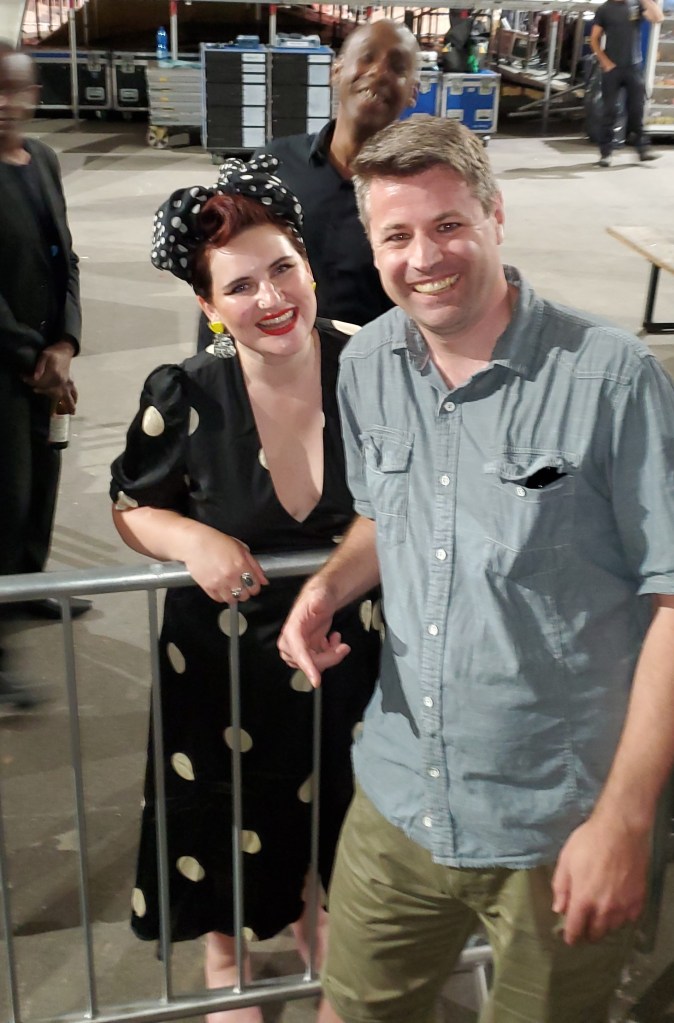
Music Director Dale Davis photobombs the author and Bronte after the show After the show, Bronte stayed to pose for photographs and talk to literally every single person who wanted to on they out. I thanked her for doing such a great job at keeping Amy’s legacy alive. As I did so, Amy’s musical director must have overhead me and gave a smile for the camera as he walked on by.
I was a little nervous asking a stranger in a large, foreign city to take my photo, as I wasn’t even sure that anyone would be able to understand my English–and then I realized: Literally every single one of these concert attendees speaks English, because they just saw an English music show! After I thanked Bronte, I thanked my photographer, and headed back to Holešovice.
Tomorrow is a new day . . .
-
Giddy as a schoolboy: first trip to Prague Castle
Dateline: July 15, 2022
What better time than to write about my first trip to Prague castle than after the disappointing box office debut of Indiana Jones and the diaper of dysentery?
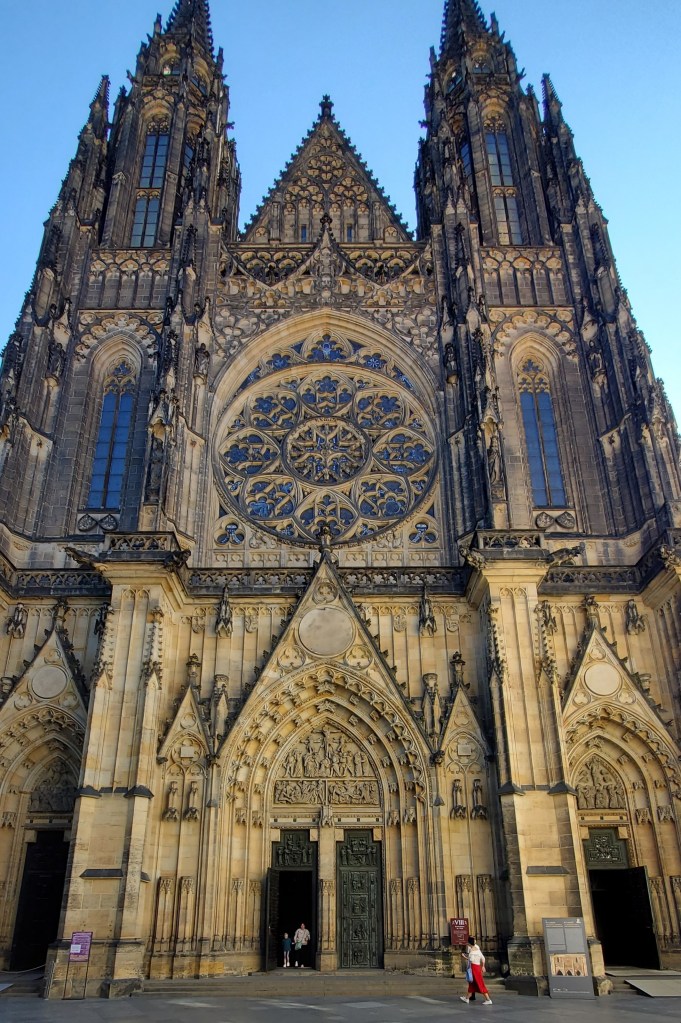
St. Vitus Cathedral dwarfs its puny human visitors Prague castle is situated just below the crest of a hill and overlooks the historic neighborhoods of Staré Město and Malá Straná. Conversely, those in the aforementioned neighborhoods on the banks of the Vltava River stare up in awe of the castle that perpetually gazes down upon them. I arrived early in the morning–so early that the ticket office wasn’t even open yet. It was 8:45 AM, and the hordes of tourists had yet to clog castle complex. The castle grounds are open to the public at 6, while the historical buildings don’t open until 9. And although the grounds of Prague Castle are free, its most prominent attractions–such as the cathedral and the bell tower–require a ticket prior to entry. I enjoyed a few luxurious moments of near-solitude as I casually strolled across the castle’s main square, and as soon as the ticket office opened, I made like a bee line to the front desk to purchase my ticket.
Visitors have the option of purchasing tickets for individual buildings, or what they the “circuit ticket.” The per unit price is lower, and it gives the visitor a chance to visit all that Prague Castle has to over: St. Vitus Cathedral, Old Royal Palace, St. George’s Basilica, the bell tower, and Zlata Ulice. I opted for the value pack and saw that my ticket was marked with Roman numerals, each of which corresponded to a historical building within the castle. In my excitement, I opted not to take a complimentary map and instead explore the sights on my own terms. Prague Castle, here we go!
Roman Numeral I is the easiest to find. As soon as you exit the ticket office, you walked from the auxiliary square into the main square of the complex, and a massive cathedral greats stares you down as you gaze up in awe. Although construction of St. Vitus Cathedral commenced in 1344, it was not completed until 1929. Yes, it is a structure six centuries in the making. After I admired its splendor in the morning light, I took a deep breath and walked through its majestic doors.
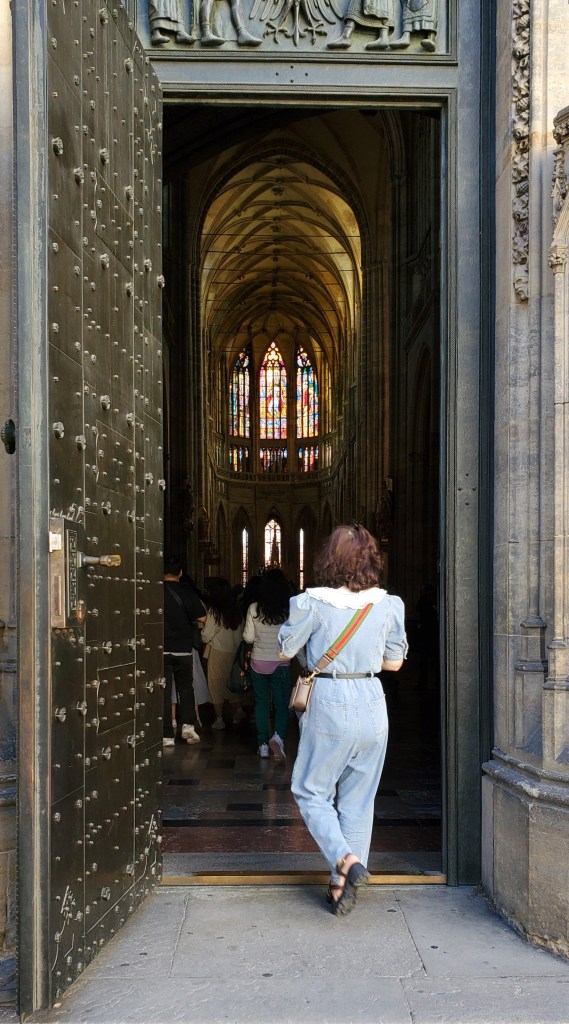
A guided tour group enters the historic St. Vitus Cathedral Once inside, the morning sunlight illuminates the stained glass windows within. Perhaps the hunchback of Notre Dame could have visited this Cathedral, as its splendid artwork forces one to look up and admire its sheer beauty. If you’ve got bad posture, St. Vitus Cathedral is a must visit.
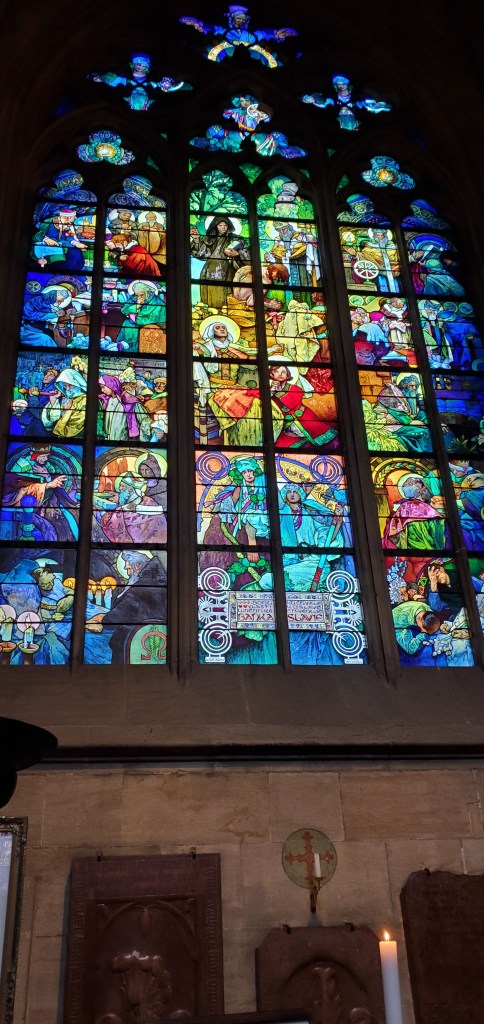
True colors: the morning sunlight illuminates one of the many stained glass windows of St. Vitus Cathedral I circumnavigated the cathedral from front to back, and took time to visit its multitude of auxiliary rooms as well. All the while, I kept an eye out for Roman Numeral X: the bell tower. Seeing none, I exited the Cathedral and walked onward, past the fountain in the main square, and towards the lesser sized of the two religious buildings, the Basilica of St. George. Constructed in 920 AD, it is the oldest edifice in Prague Castle, and a sense of the ancient permeates the air within its very walls. There is a visceral sense of the many people who lived here and died here, and you are humbled in the knowledge that you to are just a passing visitor through time and space. In a moment of thoughtful contemplation, I placed my hand on one of the walls, and thought of the artisans who constructed these walls almost two thousand years ago.
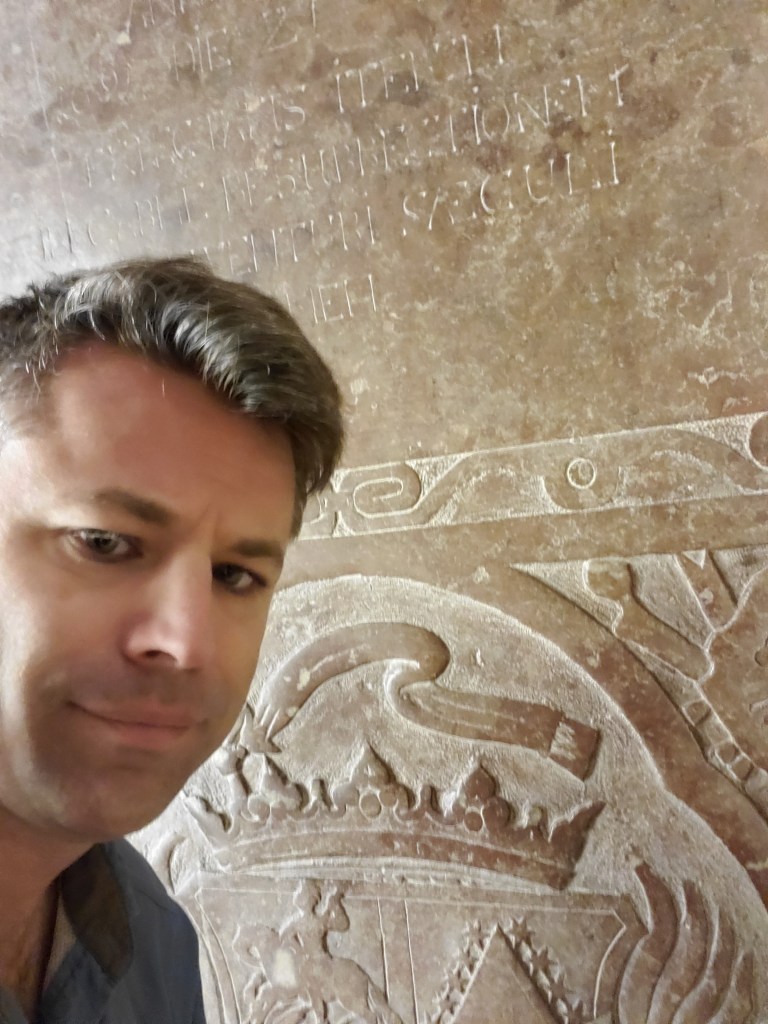
The author contemplates his place in the universe inside St. George’s Basilica It’s not all a drab, dark interior, either. Look up, and you are treated to quite a sight.
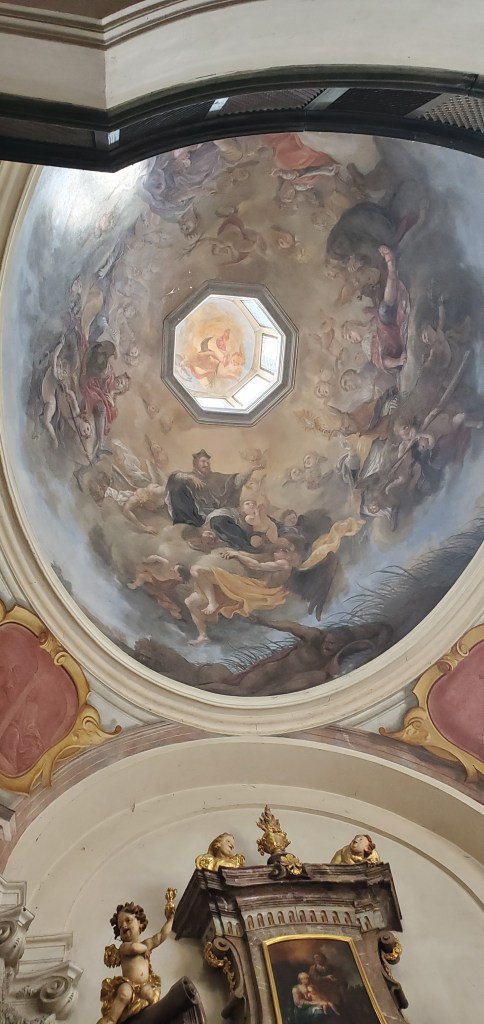
The ceiling of St. George’s Basilica Hardly satiated, my quest for history was a hunger that was only heightened as I walked back outside. I searched further for Roman Numeral X, and instead saw a sign for Zlatá ulička.
In my limited Czech, I understood “Zlatá ulička” to mean something like “Street of Gold.” Loosely translated, this phrase means “Golden Lane.” So when I looked at my ticket, I saw that I had purchased the right to passage through this part of history.
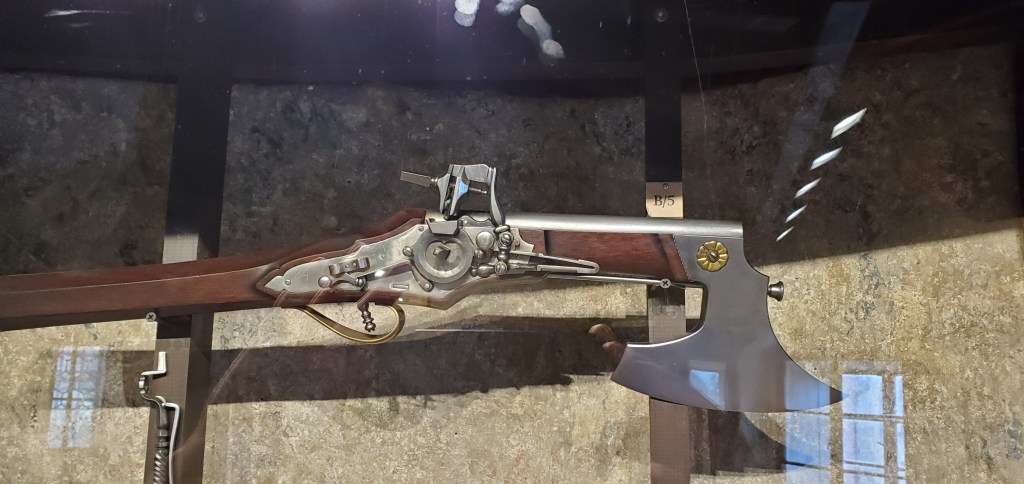
FInally! A tool for those who need to shoot something at point-blank range, and then cut down a small tree. This hatchet gun is one of the many artifacts on display in between the many tourist shops at Golden Lane. Up until the 1950, Golden Lane was home to the workers of Prague Castle. These tiny dwellings, no larger than a typical college dorm room, were home to the blacksmiths, the seamstresses, and goldsmiths who manufactured the metals, clothing and jewelry for the castle. It was the preponderance of goldsmiths that gave this street it’s moniker, “golden lane,” although today, it’s most famous historical resident is a writer: Franz Kafka, who lived there for a the summer of 1916. These two dozen small apartments (which shared one bathroom!) housed workers up until the 1950s, when Soviet authorities declared such living unsuitable for modern life and moved the few remaining residents to panel houses. There are some historical artifacts on display, but mostly souvenir shops with exorbitant prices. For example, I saw a bar of soap for sale at the price of 79 crowns (roughly four dollars). I thought to myself, I do need soap, but I can literally buy this exact same bar at a neighborhood shop for less than half the price.
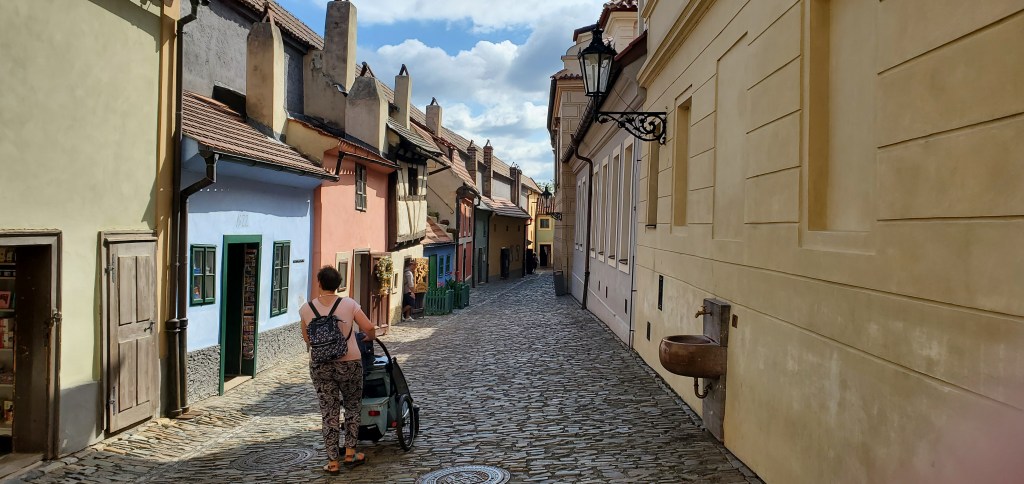
A lone shoppeaker awaits a lone tourist in Prague Castle’s Golden Lane After Golden Lane, I continued to walk downwards–down the slopes of the hill and downward into the depths of humanity. I saw a sign for “Dalibor Tower,” but it’s quite a misnomer, as this tower is a dungeon that housed the few political prisoners who dared to defy the kings of medieval Bohemia. With no numeral X in sight, I knew this wasn’t the tower I was looking for, and turned around. I still had to to find the entry for the palace and the bell tower.
I saw a small line at a building on the edge of the western edge of the main square, and saw a sign marked “Palace.” Well, it obviously wasn’t a massive bell tower, but it was another place I could visit with my purchased ticket, so I headed inside.
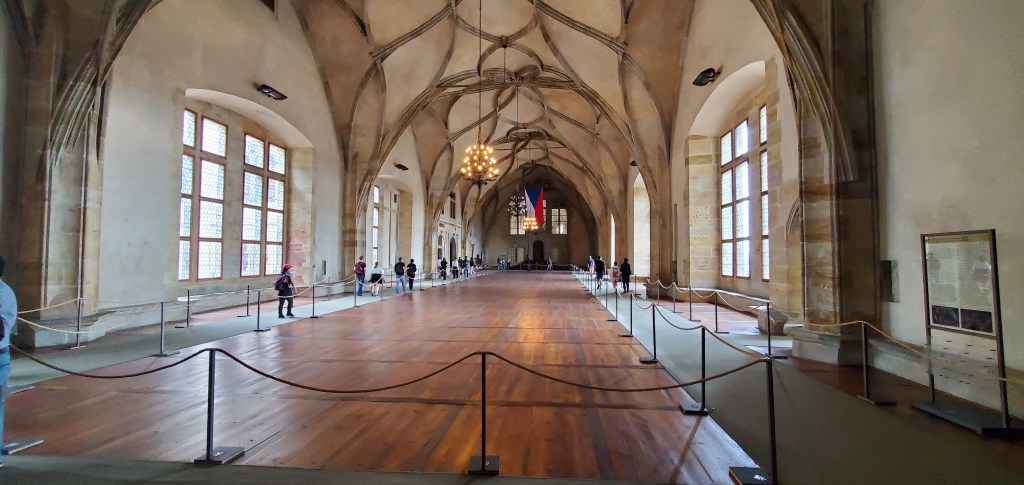
Vladislav Hall sits on the third floor of Old Royal Palace, and has served as the official gathering place for secular state functions from the 1600s to today. This ticket allows entry to the top floor of Old Royal Palace. Unlike the cathedral and the basilica, this building has been reserved for strictly secular state affairs. The third floor, named Vladislav Hall by King Vladislav II (clever name, eh?) is still used for official Czech state functions in the modern era. Just a few months after my visit, it is where Petr Pavel was sworn in as Czechia’s fourth president.
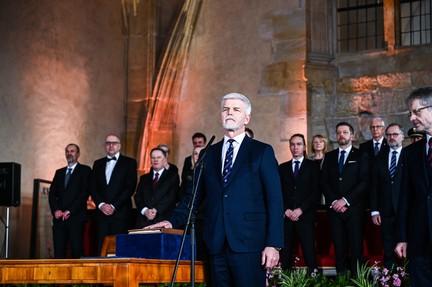
March 9th, 2023: Petr Pavel is sworn in as president in Vladislav Hall As I excited the palace, I seriously contemplated heading back to the ticket office to obtain my complementary map of the castle grounds. However, I thought about what Henry Jones, Sr. said to his son Indiana in The Last Crusade. “I find that when I take a look back, the situation reveals itself. So I walked to the southern edge of the main square, gazed up at the massive bell tower that stood before me, and sure enough, the situation revealed itself. At the foot of this massive structure is a small sign with a large x. I was so fixated with the top of the structure I hadn’t noticed the entrance at the bottom when I first walked right past it! I smiled at thought back to the last good Indiana Jones movie. X marks the spot!
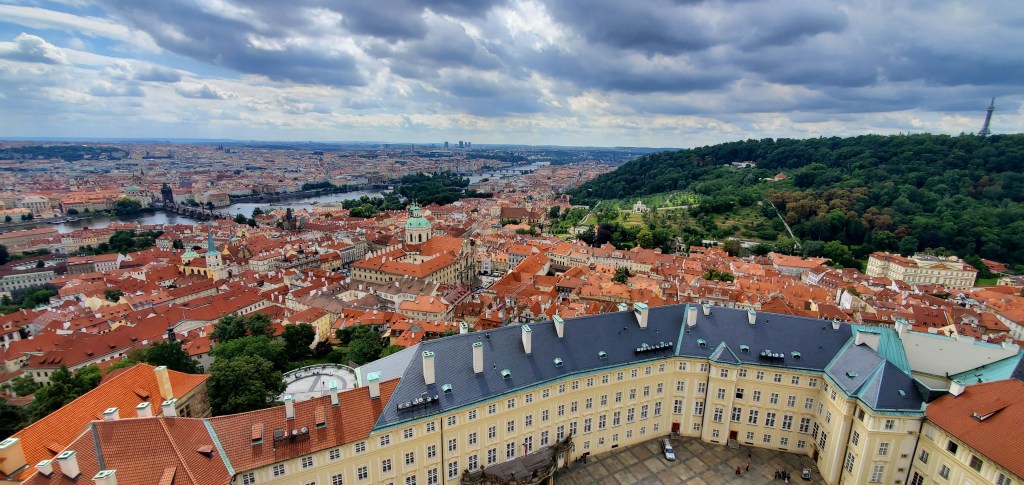
A birds eye view from the top of the Great South Tower. On the left is Charles Bridge. Just beyond the castle walls is Malá Straná. On the right, Petrin Tower.
Officially named the “Great South Tower,” the view from the top is as dizzying as it is breathtaking. I climbed 287 steps to reach a height of over 100 meters from the ground below. The fact that this building is already close the the crest of one of Prague’s largest hills makes the view all the more magnificent.
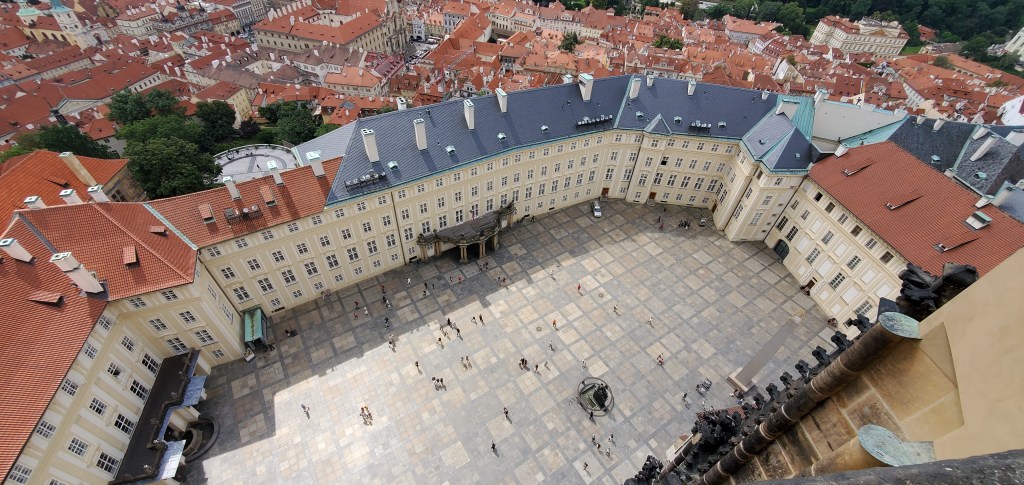
A view looking directly downwards from the Great South Tower This trip was a success, map be damned. I had seen the world in a way that I had never seen it before–seen things and touched things that were (and still are) an integral part of Czech society. Who knows what exciting adventures await?
Tomorrow is a new day . . .
-
Adventures in grocery shopping
Dateline: 4 April, 2023
When people told me that Americans have difficulty adapting to shopping in Prague, I simply had to see it to believe it. And my goodness, after living here for nearly a year, this Sunday morning marked quite another saga in this interesting and unexpected adventure.
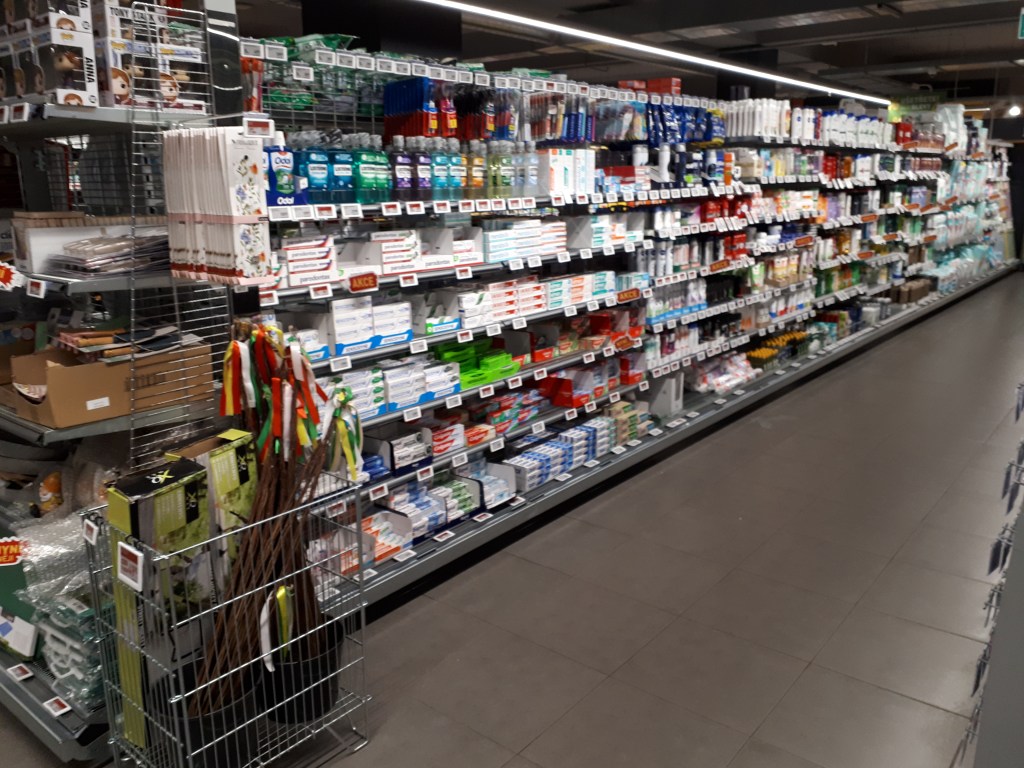
Yes, this Prague supermarket sells pomlázka whips in its health and beauty isle. First, a little background: Since the breakup of the Warsaw Pact in 1989, when the former Soviet block countries dismantled the total control of a state-owned economy in their respective countries, the result has been, how shall we say, mixed? Here’s just a list of a few unusual things I’ve had to adopt to when shopping for food and other necessities:
Variety is a luxury, as is consistency. I’ve lived in three different neighborhoods since my arrival in Prague last summer, and only one neighborhood grocery store had the exotic food item known as tofu. Tofu! Sure, if I lived in Vinohrady or Little Hanoi, tofu would be easier to find, but the rest of Prague hasn’t really caught on to such cosmopolitan cuisine. But there’s always an abundance of Pilsner and Budvar!
However, not everything in the supermarket is as consistently stocked as Prague’s prestigious piva. For example, the Tesco in Hradčanska has chickpeas but not baked beans. The Tesco in Anděl has baked beans but not chickpeas. Same store, different neighborhood. In other words, American expats can forget about one-stop shopping or simply narrow their tastes.
But that’s just food. Another thing that is interesting is that drugstores don’t sell drugs. Seriously. There is no pharmacy in any drugstore. Picture CVS or Walgreen’s without any food in the front or pharmacy in the back. But you’ll see plenty of cosmetics and vitamins! Anyone in need of any actual medicine will have to go to a Lékérna, which, in and of itself isn’t particularly problematic, but it raises the question: Why call your store a drogerie when you don’t sell any drugs?
I’ve navigated this new environment without much difficulty (and it helps that I’ve had local Prague person helping me obtain groceries since September), but today’s adventure at the local Billa seemed worthy of commemoration.
I promptly arrived at the Petřiny Billa at 8 am to purchase a few staples: rolík, mléko, Budvar, and soap. Yes, soap. I filled my basket with the food and drink that I needed, but when I walked to the health and beauty isle, one item was conspicuously absent.
Of course, it was soap. Even though they had every other health and beauty product known to humankind, every variety of shampoo, conditioner, toothpaste, toothbrush, hand creme, shaving cream, and face cream, somehow the most essential cleanliness product of all was completely absent from the shelves. So if I wanted soap this morning, I would have needed to go the the drogerie. And yes, as you can see in the photo, this supermarket even had a supply of pre-fabricrated pomlázka whips for Easter Monday.
For the unitiated, the pomlázka is a whip constructed from willow branches, which boys are supposed to go out into the forest and construct by hand, after which they return to whip the girls. This annual Easter Monday dates back to pagan times, and somehow has managed to last in our present, 21st century. Many Czechs believe, as their ancestors did, that whipping women with the “stick of youth” endows her with health and fertility. In fact, the word “Pamlazka,” roughly translated from old Czech into English, means “stick of youth.” This springtime tradition is restricted solely to Easter Monday. So of course, today my neighborhood Prague supermarket had this nugget of ancient superstition in its healthy and beauty aisle (Na zdraví!) but not soap!
Fortunately, my bathroom isn’t completely empty at the moment, so my trip to the drogerie can wait for another time. So I left without soap, and of course, without the Pomlázka. Not to brag, but I think there are other ways to stay forever young.
Until next time, Na zdraví!
*This article has been edited from its original form to more properly reflect the true origin of the Czech word, “pomlazka.””
-
Another Milestone
Dateline: March 3rd, 2023
Two milestones, actually.
The first milestone is that I now have a cell phone service plan with a European provider, so I am no longer at the mercy of my prepaid sim card. The other milestone was far more important in the grand scheme of things, and tasted much better as well.
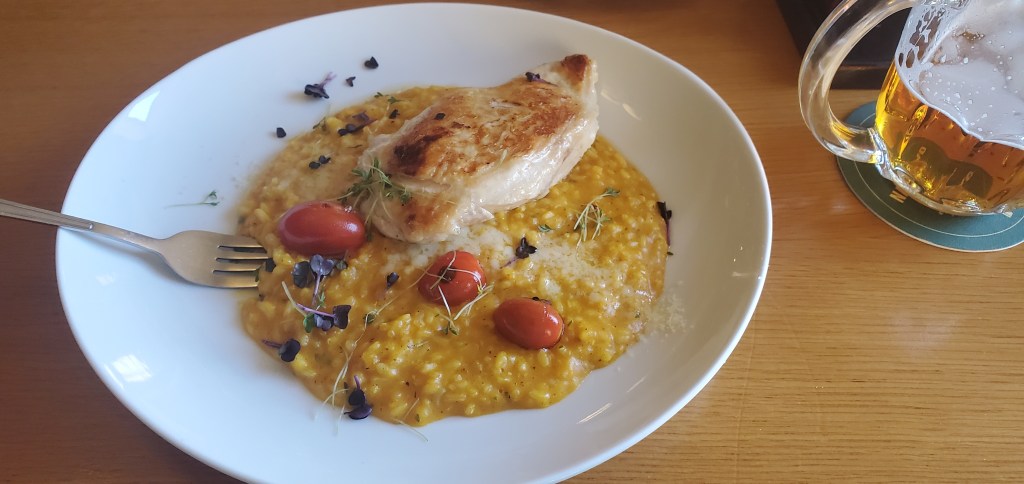
Kuřeci se rajcaty, a jednou velke pivo What you see before is my first meal that I ordered and paid for entirely with my use of the Czech language. No translation apps. No spurts of me stumbling and fumbling in Czech before I finally asked the server if they spoke a word of English. I could read the menu. I spoke with perfect pronunciation, courtesy of the many people here in Prague who have helped me practice my “ř,” a skill that took months to master (In case you’re wondering, ř is pronounced by simultaneously rolling your tongue with the Spanish “rr”sound, while also pushing your tongue to the roof of your mouth to make the “zuh” sound in pleasure.) As is nearly always this case in Prague restaurants, the food was fantastic, but I really that I had earned something with every bite. It made the food taste so much better in ways that I previously hadn’t though possible.
When I was done eating, I placed my knife and fork neatly parallel on the plate, as is the traditional Czech custom. The server asked me if I wanted another Pivo, and I said I would pay, as well as add a spropitné (gratuity) of 20 crowns for service. The server’s pupils dilated like saucer plates. “Tip is not included,” she said in English, as she pointed to the bottom of the bill which stated the same in plain print. “Ja vim,” (I know) I said. Then reiterated again, in Czech, that I would like her to add 20 crowns to my bill for her service. She smiled and obliged.
With a “hezky den” and a “na shledenou,” I was out the door, and into Vítězné náměstí, or “Circle Square” as the locals call it. Another week was over, and I had achieved another milestone. I reflected on what had just happened, and looked to the setting sun with anticipation of the milestones yet to come.
-
Reflecting back, looking forward . . .
Dateline: 29 December, 2022
What a long, strange year it has been.
So much has happened to me just in the the last three months alone that I don’t even know where to begin. I had a wonderful summer in Prague. I completed my certification in teaching English as a foreign language. I started my new career as an English foreign language teacher. I met some very interesting people. And I fell in love with a beautiful Bohemian woman.
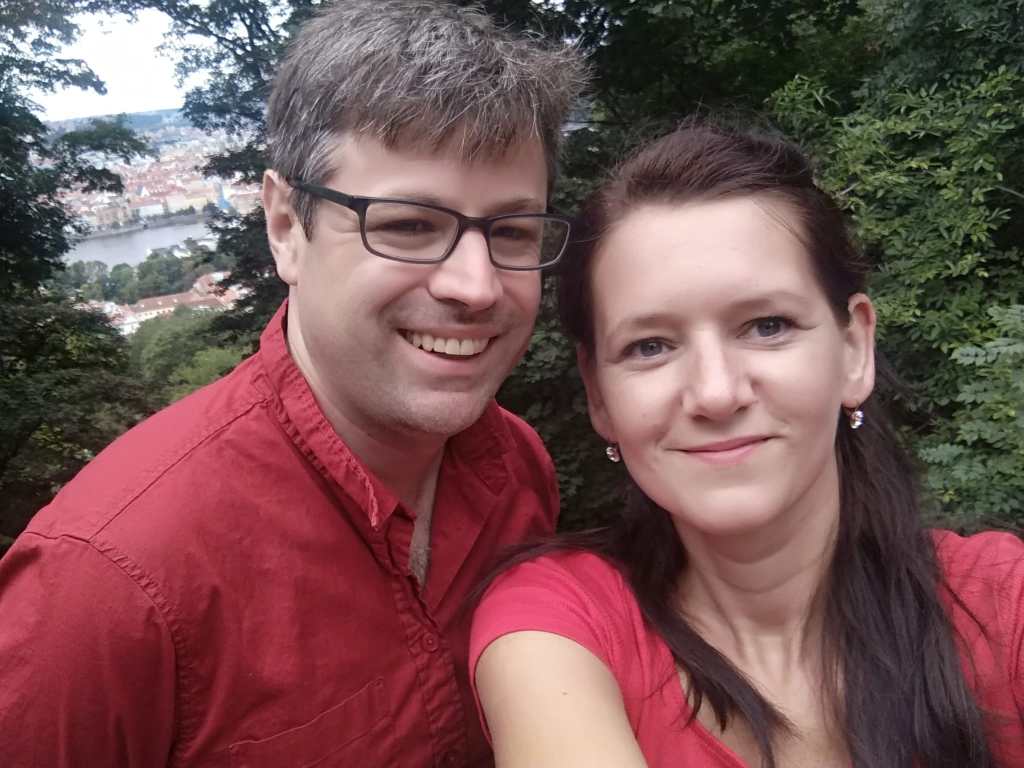
Love is all around me . . . and so the feeling grows 😉 In our era of instant gratification, people ask my why I don’t publish here more often. I humbly remind them then when it comes to writing, I like to put quality first, and if that means I must write less often, then so be it. However, even though I haven’t been publishing, I have been writing. Rather than publish a few half thoughts and photos on the various (anti) social media platforms, I wrote my thoughts with ink on paper, mere drafts to be published at a later date.
It was during this drafting process that one of my students asked if I, an American and therefore an obvious fan of baseball, was aware that that the Czech national baseball team had defeated Spain and thus, qualified for the 2023 World Baseball Classic. I told my student I wasn’t even away that the the Czech Republic even had a national baseball team.
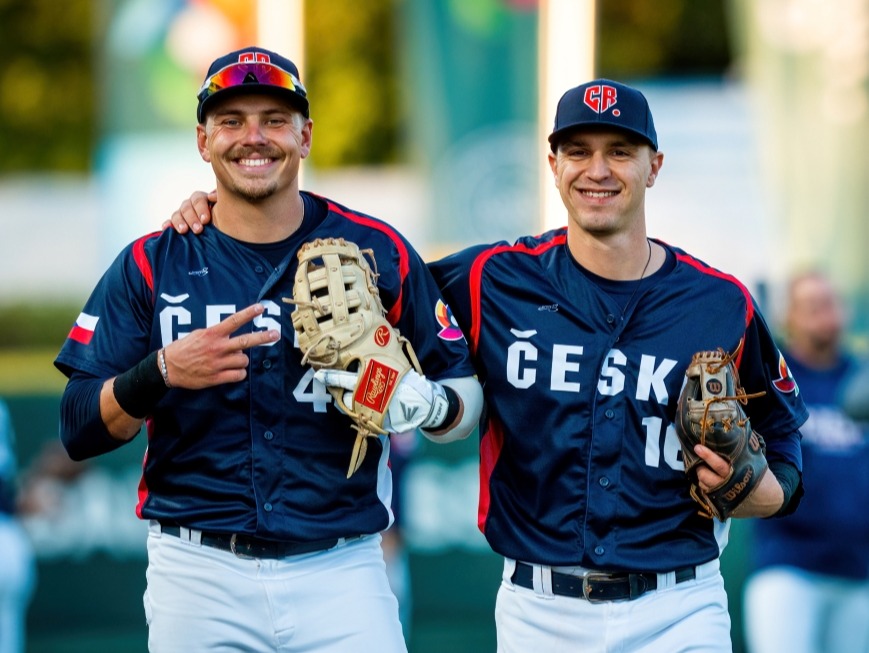
Czech baseball players are all smiles after defeating Spain and earning a spot on the 2023 World Baseball Classic Tournament. “Oh, we do,” my student replied. “It’s a baseball team like no other. The pitcher is a fireman; one of our other players is a doctor.”
When I heard that, my thoughts immediately raced back what many refer to as baseball’s Golden Age. Before free agency. Before television. Before multi-million dollar player contracts. I thought of Dominic DiMaggio’s memoir, Real Grass, Real Heroes. Dominic, younger brother of the much more famous Yankee slugger Joe, also played major baseball, but for the arch-rival Boston Red Sox. Dominic’s memoir focuses almost exclusively on the summer of 1941. When that was summer over, baseball nearly ended with it, as nearly all the most famous players of the era–as well as all military-aged young men who would have played in the minor leagues to grow and develop into better players–enlisted or were drafted into World War II.
Bob Feller was the first to enlist–a mere 48 hours after the Japanese bombed Pearl Harbor, Feller enlisted in the United States Navy. At the time, he had been averaging 25 wins per season and over 250 strikeouts per season. For three years, Feller served in the United States Navy, seeing combat and serving in both the Pacific and North Atlantic. His career numbers, impressive as they were, would have been all the more spectacular if not for his military service. Fans would ask Feller how he felt about sacrificing so much of his career to World War II, and Feller would invariable respond: Defeating the Germans and the Japanese was the Greatest Victory.
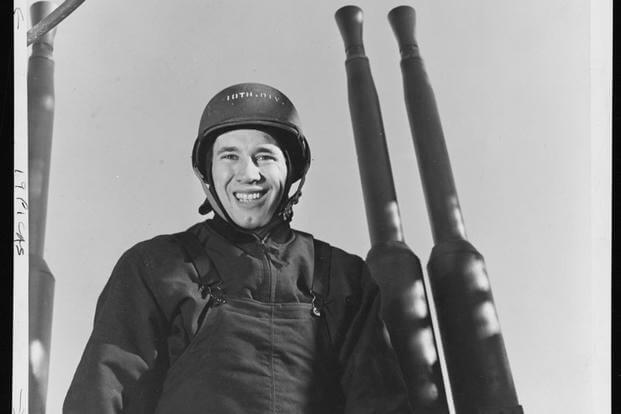
They called him “Bullet Bob” for his blazing fastball, but Feller’s fight against the forces of fascism during World War II gave his nickname new meaning. And yet after this Greatest Victory, when players returned to the field on opening day in 1946, baseball, and the world, would never be the same again. Dominic writes about these changes in his memoir, how some are easy to identify, but others, hard to describe in words, just a general feeling of difference. Baseball would change much more in the years to come–astroturf being the chief atrocity among them–but Dominic doesn’t let his opinion to which changes are good are bad, and simply lets you, the reader, decide for yourself. For example, only the most blatant racists would ever take issue with Jackie Robinson, a man who broke baseball’s color barrier before the 1964 Civil Rights Act, before Rosa Parks and the Montgomery Bus Boycott, and before Harry Truman desegregated the U.S. military.
One jaw-dropping difference is that of player salaries. According to Dominic, his brother Joe was one of the only ballplayers who could afford private transportation to spring training in Florida. Others had to carpool, and in the era before the Interstate Highway System, this was a long, grueling trip. If you got stock behind a truck moving slowly uphill–to bad. You and your teammates had to wait until after the crest of the hill to pass the truck. You and your teammates also had to take turns driving. Another point of contention was whether or a ballplayer had to work a second job during the offseason. While the top players of the era earned enough money to rest and recover during the winter months, other players had to work second jobs to make ends meet. Obviously, these players were less than enthused about driving from end of the country to another at the start of spring training. One can only wonder what those conversations as to “it’s your turn to drive!” would have sounded like in the time before American athletes were multi-millionaires.
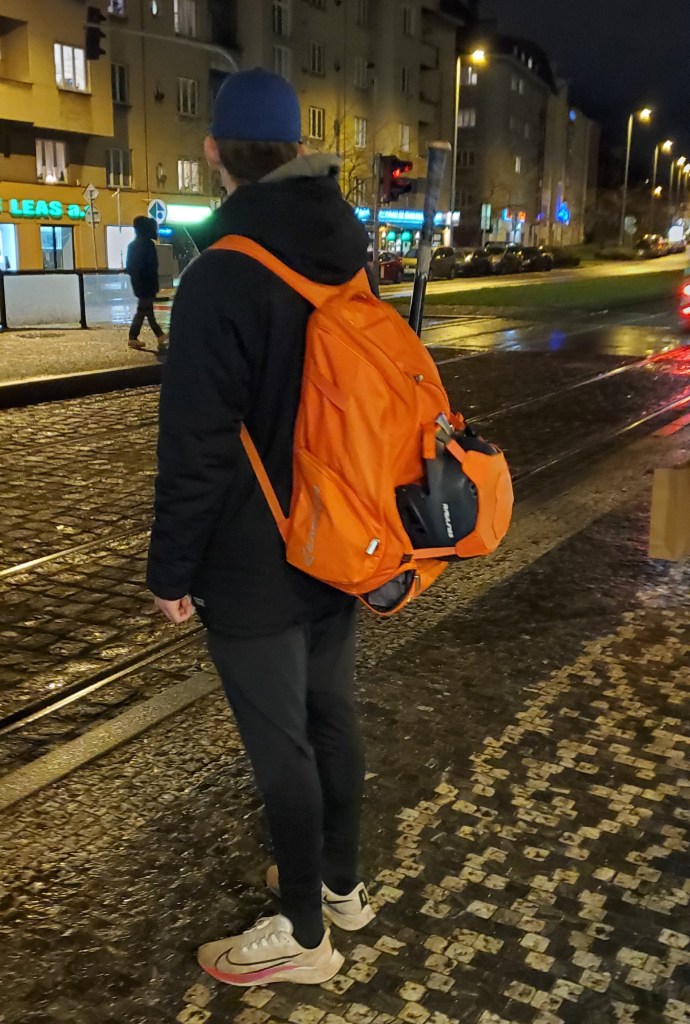
A sign of things to come? A Czech ballplayer waits for the tram at Hradčanská And yet here in Prague, that time is now. Baseball, America’s national pastime, is catching on in the Czech Republic. Granted, the Czech’s I speak to are either unaware of their own baseball team, or very cynical about their team’s chances–one Czech baseball player even told me: “I think we are going to get our asses kicked!” Given that their best player is a catcher who never played higher than AAA and is currently studying for his Master’s in Business Administration, it’s a hard point to argue with. And yet my response each time is the same. Dismal as the Czech national baseball team’s chances may be, the way they play is simply inspiring. With grit, determination, hustle. Heart. No matter what the statheads say, that is the winning formula for any championship team. And I warmly invite anyone who doubts me to simply look up which team defeated the 2002 “Moneyball” Oakland A’s.
So yes, I have much to write about. And I will continue writing about my experiences this summer, this fall, and during my first Christmas in Europe. I will continue to hope and state publicly for peace in eastern Europe and elsewhere. I don’t know what the future will bring, but I will continue to humbly hope that in the some way, I can contribute towards the greater good of mankind simply by documenting my experience in heart of Europe.
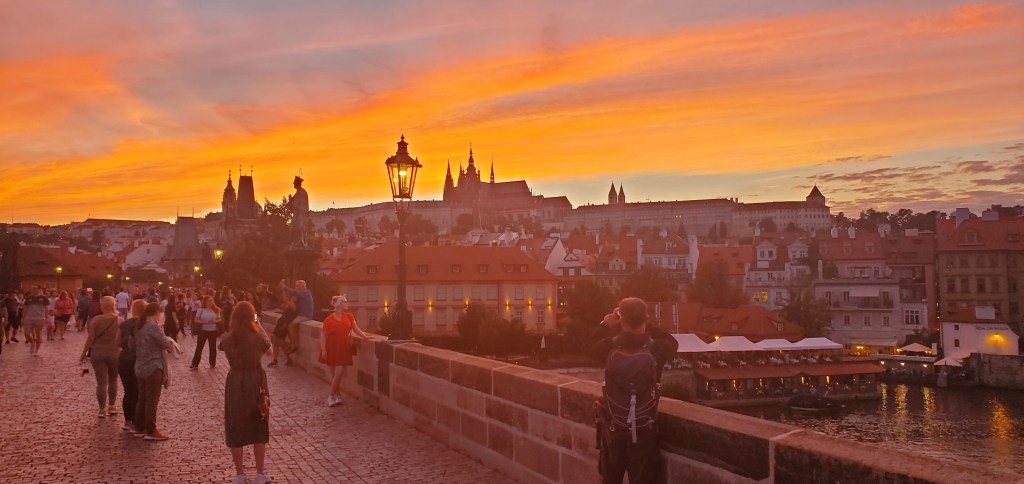
The sun sets over Petřín Hill, illuminating Prague Castle and the Charles Bridge. And as another American in Europe reminded us, the sun also rises . . . Until next time . . .
-
Subscribe
Subscribed
Already have a WordPress.com account? Log in now.
 A Connecticut Yankee in King Wenceslas's Court